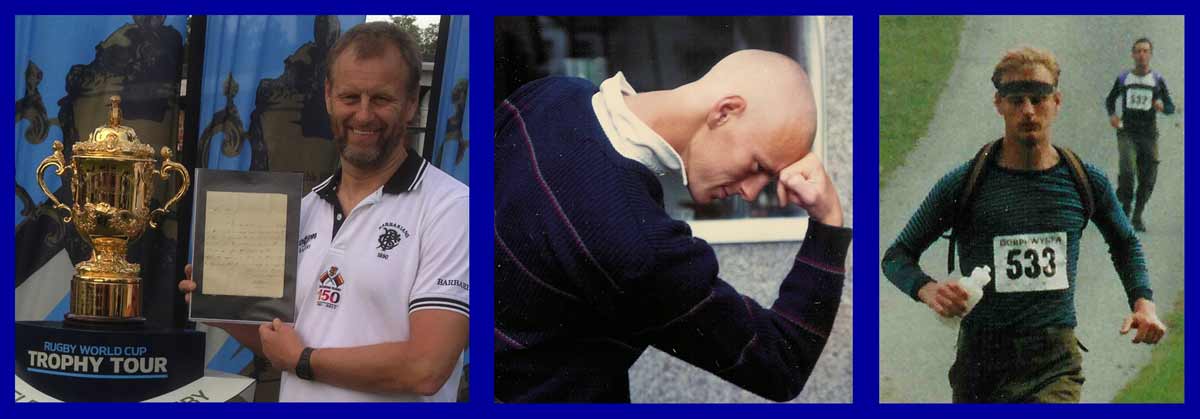
| Hello, how do you do? My name is David, my kids call me Dad, my Mrs and close friends call me Dave, in the local swimming pool they call me Dai Splash and when I’m doing karaoke I’m called Shy Dai. Lyn Jones the rugby coach calls me Dai Rucksack and I’m known as Dai ‘something or other’ in several other places. That’s just the way things are in Wales, most of us are called David, or Dai for short, followed by our occupations – ‘Dai the Milk’, ‘Dai Barber’, ‘Dai Banknote’ (the accountant) – or followed by a trait – ‘Dai Bungalow’ (nothing upstairs), ‘Dai Cakey’ (likes cakes), ‘Dai Bend the Truth’ (tells lies), Dai Tra La La (member of four choirs) etc. This book is about a journey I’ve recently undertaken. About how I learnt to understand the origin of the sport of Rugby Union, and there was a point on this journey where I was the only person alive with this knowledge. But I don’t want to be known as ‘Dai Lonely Origin’, so I’d like to share this information with you. Please join me in my journey of understanding as I tell it like my singing buddies Frank Sinatra & Sid Vicious ……………… ‘My Way’ The journey began at the dentist, halfway between the hygienist and my check up with the main man Matthew White – he once met Roald Dahl you know – but that’s his story, back to mine. My phone rang and I didn’t have my glasses on, so I pressed the wrong button and cancelled the call. The call was from an auction house in London where a William Webb Ellis signed letter dated 1826 was up for auction. I had booked a telephone line to place my bid and I’d just cut the auctioneers off. I panicked, I was going to miss my opportunity to bid. I rang the auction house but only got through to reception. Plan B was that the auction house would ring my office number, and luckily my wife Hayley knows how to press the right buttons and say the right words, so she bought the Webb Ellis letter. 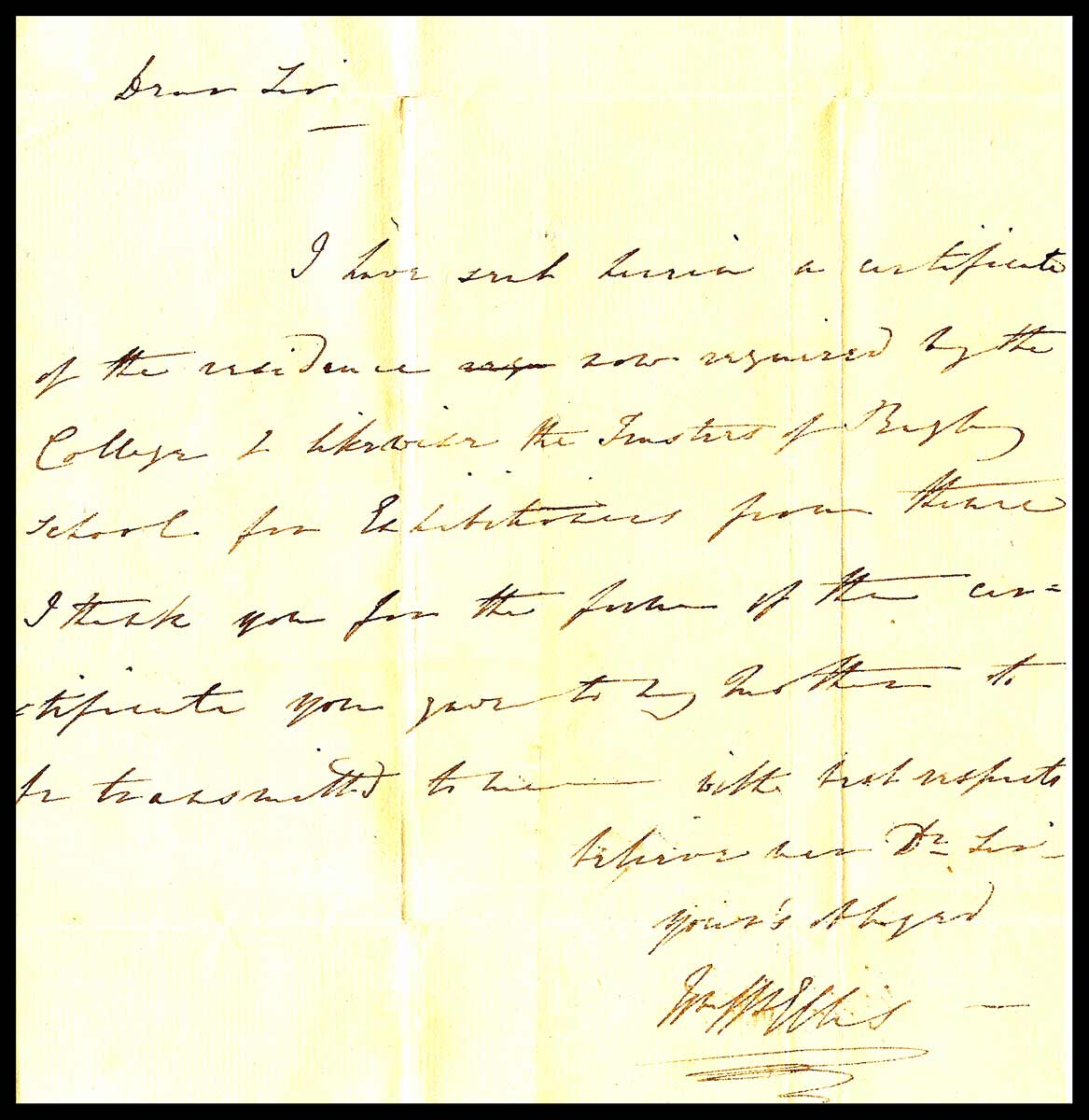
Dear Sir I have sent herein a certificate of the residence now required by the College & likewise the masters (?) of Rugby School for Exhibitioners from there. I thank you for the ??? of the cer - tificate you gave my mother to be transmitted to her (?) with best respects ???? ???? Dr Sir yours obliged W W Ellis Why did I buy a William Webb Ellis letter? I started collecting rugby memorabilia in 1968, I was only 8 years old at the time, just a lad, and I continued collecting rugby things as a child, building a collection that focused on my favourite club, Neath, and my country, Wales. I started working in 1978 and also started buying memorabilia from dealers. Sometimes the things I wanted from the dealers had already been sold when I went to buy them, so I thought to myself ‘how can I get these things before the dealers do?’ I started wheeling and dealing myself to improve my collection and I was good at it, so in 1991 I started Rugby Relics – a business that focused entirely on selling rugby memorabilia. The collection improved and to showcase it ten years later I opened the world’s first on-line rugby museum www.world-rugby-museum.com. Since then I have displayed some of my collection at the Welsh Rugby Union’s 125th anniversary exhibition and at their 130th anniversary dinner, but I always struggled to show something that linked in with the development of the sport at Rugby School. With my Webb Ellis signature in hand I now had the means to do this, with what I believed at the time to be the oldest existing item of rugby memorabilia. I’ve always been intrigued by the William Webb Ellis story. I’ve read several books and articles that have written the story off as myth and, as a rule, I tended to agree with these theories without questioning them. So I set out to learn about the Webb Ellis story and how he was supposed to have invented the sport of Rugby Union. I only intended to write a short article, it was just going to be a page on the website, but the more I delved into the origin of rugby, the more I wrote about it and the more I realised that there was a general lack of understanding about the origin of Rugby Union and about the origin of a sport in general. Then my article became too long for a single webpage and ‘writing a book’ was on my bucket list, so here we are today. It’s a happy first book for ‘Dai Author’ or ‘Dai Origin’ as I might become known in the future. I would like you to join me in analysing the origin of the sport of Rugby Union, so from here on in every so often I’m going to use ‘we’ and ‘us’, and when I say ‘we’ or ‘us’, I mean you, the person who is reading the book and me, the one who has written it. At the beginning of every chapter I’m going to let you know what the aim of that chapter is, but first here is the aim of this book. AIM – To understand the origin of the sport of Rugby Union. At the end of every chapter I’m going to give you a SUMMARY – On what we’ve talked about in the chapter and a CONCLUSION – On what we’ve decided This may be followed by a FOOTNOTE – A note that is at the foot of each chapter. Everyone is different, I have my own style of writing, which you may or may not enjoy. The topics I’m covering in this book are quite serious so I’ve tried a Jekyll & Hyde approach to the book. I hope it’s a good analogy because I haven’t read that book. Within the chapters themselves I’m trying to be Dr Jekyll, seriously analysing the origin of Rugby Union. But in the footnotes I let loose with my own personality. I’m not so much of a Mr Hyde, more of a Mr Silly, but if this is to be my only book I want it to reflect some of my eccentricities. Think of it this way: put yourself in the shoes of a top Association football player (a footballer, a soccer player, whatever you want to call him or her) playing in a cup final. You’ve just spent 90 minutes focusing entirely on one thing, on winning a game of soccer, and you’ve pushed yourself to the limits of physical exertion. You’ve just scored a goal, it was the winning goal and it was in the last minute. You have to celebrate, run around and do silly dances, because that’s what soccer players do. This book is my cup final, I’m Welsh and I’m a Welsh sportsman who as a rule doesn’t write books, so when I finish a chapter I’m going to celebrate and I’m going to sing in celebration, because that’s what Welshmen do when they are happy. We sing. This is a bit difficult on paper but you’ll get the gist of it as we go along. You may or may not enjoy my style of writing and so to help you decide on the best way in which way to approach this book, here are four options on how you can get the most out of it: 1. I’M IN A RUSH – If you are in a hurry, turn straight to the conclusion in Chapter 11 to read about how the game of Rugby Union began, close the book and have a nice day. 2. I’M TOO SERIOUS TO READ YOUR BOOK – Although I love to have fun and chat a little, I’m serious about sport and once you get into the book you’ll find it very informative and downright serious. I also hope to write a follow up book focusing entirely on the origin of Rugby Union so you may wish to wait for that. 3. I’M NEAT AND TIDY AND DON’T WANT TO MARK THE BOOK – There are a few options for adding photos in the book, for writing information about yourself and participating in the study of a sport; you don’t have to do this if you don’t want to. Some people just don’t mark books and if you are one of those people then that’s fine. 4. I WANT TO JOIN YOU ON YOUR JOURNEY OF DISCOVERY – Great stuff, glad you’re on board, let’s go…………… So that you can put a face to the words, here are three photos of myself.
|