AIM – To look at the belief held by modern day historians that the origin of rugby lies with folk football. What do the sources of reference for the early history of football tell us and how do they relate to the game played at Rugby School at its earliest accepted origin?
Where shall we start? If we refer back to the recording of the game, the early histories of football all mentioned folk football, so let’s start with those.
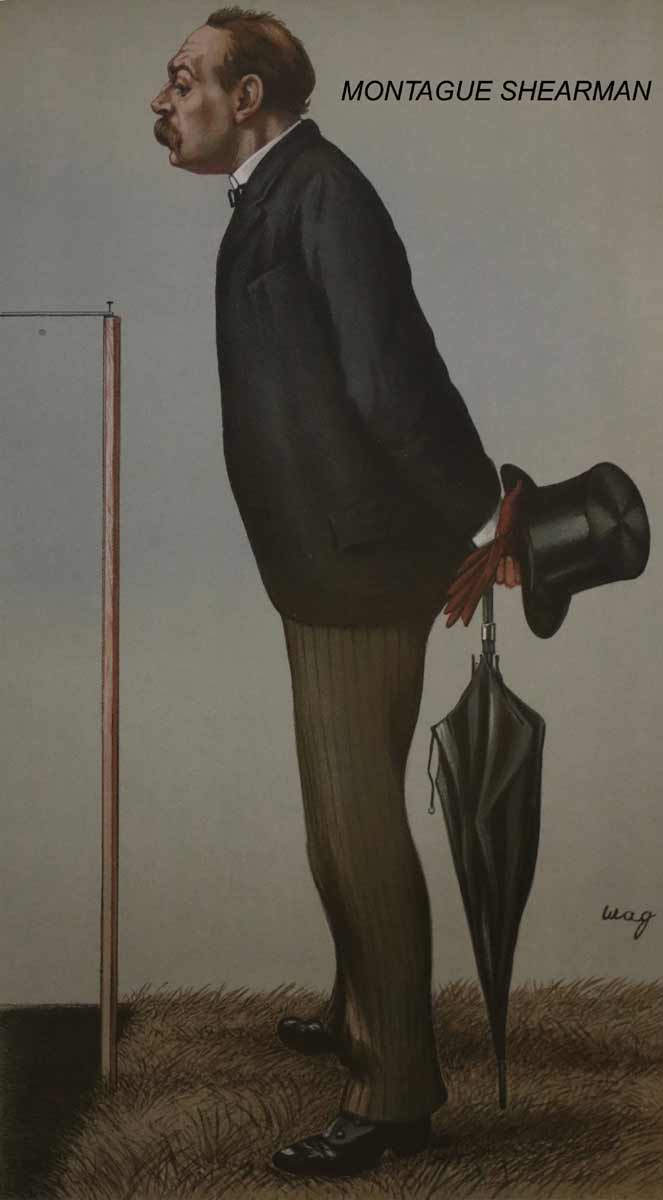
Although Routledge’s 1867 Handbook of Football covered the many versions of folk football, he stated plainly that he knew not of the origin. Therefore, the first publication we will look at is Montague Shearman and James E Vincent’s ‘Foot-ball – Its History for Five Centuries’, published in 1885 by Field & Tuer. In their preface, Shearman & Vincent state:
“There also resulted a theory, which was not adopted without anxious argument, that the games of football now in vogue owe their origin almost entirely to the public schools; and that in the public schools rules were the consequence of circumstances and environment. At the same time football has a history which has been faithfully followed.” – MSFC0pf.v
The important words to note in the above statement are ‘almost entirely’, meaning that not every form of football played in the public schools was developed internally within the various schools. There was an exception and later on in the book the authors identify Football at Rugby School as being the original folk football game (MSFC048).
In the opening chapter, the authors briefly discuss the possibility that the history of football had two legends. Of one – (folk) football as played in ancient times – referring to the Isle of Purbeck quarrymen game, they say:
“But the origin of the practice, both in that locality and in some other parts of the country where it is known to have been followed, is shrouded in antiquity; and there is little evidence to show that this practice caused the rise of football, instead of having arisen at a time when the game itself was well known.” – MSFC004
The other legend was of Barbarian hordes kicking around severed heads, including in the Chester game “…the head of a Dane is still stated to have been the original ball used in the game.” (MSFC005). Shearman & Vincent however dismiss that this was the origin:
“…we can still comfort ourselves by feeling certain that football had no such horrible origin…” – MSFC005
They do, however, draw similarities between folk football and Rugby Union:
“Sometimes we hear of goals a mile or so apart; often the arena of play was a street or a high road, sometimes a whole town; and the attacking party with the ball would try and sneak round by bye-streets in order to escape notice, and plant the ball unawares through the window or against the post which was fixed as the goal. The game, in short, when played in a confined space, was none other than a rough form of the present Rugby Union football, without the rules and prohibitions which have now reduced to order and civilised that game.” – MSFC012
The book continues to discuss various forms of folk football during and after the ‘Puritan’ era, before dealing exclusively with the ‘History of Football in the Public Schools’. The opening passage of that chapter is worth recording here because it identifies Rugby School as being the sole surviving location for the original game. However, in its entirety, the book fails to pinpoint what the original game actually was.
“It is vastly to the credit of cricket and of football that they should have survived the Puritan deluge and the decay of the athletic spirit at the end of the last century, and not have been laid in limbo together with stoolball, cambuc, and other games wherein the hearts of out forefathers rejoiced. The survival indicates an exceeding fitness. Still the storm of Puritanical hatred had been enough to kill even hardier plants than these, unless there had been some quiet haunts in which they existed unnoticed and unmolested. As to the pastimes of the ‘prentice boys they perished; but in the quiet privacy of the country and in the almost monastic seclusion of some of our ancient public schools they continued to exist.
For some reason or other, the foundation of Laurence Sheriff, at Rugby, was the locality in which, what we now call the Rugby game, but which, for reasons above mentioned, appears in reality to have been the pristine form of the game, was preserved. Now, since of every effect there is a cause, and since of this particular effect history supplies us no cause that we are aware of, it becomes necessary to have recourse to conjecture; and since conjecture, to be probable, must proceed upon some sound basis, it seems to follow, that in order to discover why the game, distinguished by an absence of rules, survived in Rugby School, an inquiry should be made whether the conditions of football at Rugby were not different from what they were elsewhere. The answer to this question, once formulated, is manifest. The conditions of football were different at Rugby from those which prevailed at other schools; or rather, to put the matter in language paradoxical in appearance but literally correct, the conditions of the game were normal at Rugby and abnormal everywhere else. In fact, the original form of football, – for it is the simplest, – is of such a nature that it can hardly be played except in a wide open space. Such a space existed at Rugby from the beginning, but not at the other great public schools.” – MSFC047
After a short summary of the Eton, Winchester & Charterhouse games, they close the paragraph with:
“Therefore it was natural in each particular school the rules of the game should be settled by the capacities of the playground; and as these were infinitely various in character, so were the games various.” – MSFC049
Simplifying the conclusions drawn by Shearman & Vincent: there were many forms of ancient football that all derived from one source – the original game – but they don’t actually know what the original game was. The sole survivor of this form of football was played at Rugby School, owing to the school’s remoteness in the country. Several other public schools played various different forms of football that each differed from the original game and evolved as a result of the nature of the environment in which the game was played.
In 1887, Shearman published ‘Athletics & Football’, in which he once again ascribed the origin of Rugby Union Football to the original game:
“Probably the name ‘football’ was first used to describe the ball itself, and meant a ball which was big enough to be kicked and could be kicked with the foot. The game of football was the game played with this kind of ball, and it was simple to an extreme degree. The goals were two bushes, posts, houses or any objects fixed upon at any distance apart from a few score yards to a few miles. The ball was placed mid-way between the two goals at starting, the players (of any number) divided into two sides, and it was the business of either side to get the ball by force or strategy up to or through the goal of the opposite side. When confined to a street, or field of play, it is obvious that the sport was the original form of what is now known as the Rugby Union game.” – MSAF250
What he says is that ancient football had three rules:
1. The ball starts on the half way line
2. There are two sides
3. The ball needs to go through the goal, by any method, for a score to be registered
In the same chapter he mentions several different forms of folk football:
Greek football & two types of Roman football – MSAF246
Chester football – where they originally used the head of a Dane – MSAF247
Derby football – which celebrated a victory over the Romans in the third century – MSAF247
Isle of Purbeck football – where the free quarrymen kicked a football over the ground they had claimed – MSAF247
Fitzstephen’s Shrove Tuesday ‘boys in the field’ football – MSAF248
London boys and ‘prentices football’ – MSAF248
London large ball football, played at the time of Edward II – MSAF248
Elizabethan football – MSAF251
Cornish hurling – described by Carew as simply being football with much running and little or no kicking – MSAF257
Camp ball – MSAF260
Football at Scone in Perthshire: “The game was the same as that known as ‘hurling’ in Cornwall, as ‘camp-ball’ in the eastern counties, and football elsewhere”…“The game was an annual one between the bachelors and the married men, and the object of the married men was to hang it, that is to put it three times into a small hole in the moor which was the ‘dool’.” – MSAF261
I mention all of the above types of folk football because it is worth taking note of the diversity. What Shearman is saying here is that because all of these sports used a ball, that they were the same, which is like saying that chess and monopoly are the same game because they are played on a board, that darts and archery are the same because they are aiming pointy things at a target, and that boxing and wrestling are the same because they are based on two people fighting in a ring. He also goes on to say that:
“The origin of the Scone game, like the origin of the annual game at Chester, Derby, Kingston, Corfe Castle, and elsewhere, is shrouded in obscurity…” – MSAF261
In other words he hasn’t got a clue how any of the games originated, but had previously (and also a page later) made up his mind that their origins were the same:
“… it is obvious that the sport was the original form of what is now known as the Rugby Union game.” – MSAF251
“However to return to our history. There is no doubt that hurling, football, and camp-ball were in their origin the same.” – MSAF262
He says this in spite of the fact that the games were in some cases played hundreds of miles apart, with different equipment, on different sized areas, with different rules. He doesn’t know how they started, but says that they all originated from the same game, whose origin is shrouded in obscurity. All of these games then became the same game – Rugby Union – even though one of those games was played with sticks.
The confusion in this publication and Routledge’s earlier ‘Handbook of Football’ lies in the fact that the authors were unable to differentiate between the various forms of folk football. Even though they are clearly different games, they cannot fathom that they might have evolved separately from unconnected sources. It must be remembered that Shearman’s book appeared just five years after the death of Charles Darwin, whose ‘On the Origin of the Species’ book ran to 6 editions, the last having been published in 1872. It’s very possible that Shearman drew inspiration from Darwin’s work and attempted to draw his own ‘tree of life’ adapted to the origin of football.
In 1892 the Reverend Frank Marshall wrote the first complete history dedicated to rugby football. Over 500 pages long, it is still the major reference work for rugby football historians. Unfortunately, in the first chapter of the book, Marshall states that he uses Shearman’s book as a work of reference.

Let’s start at the beginning:
CHAPTER 1
The Origin of the Game
“It is not within the purpose of the present work to give a detailed and exhaustive record of the ancient games of football or to compile a history of the game as played in this country for so many centuries. The ancient records have been so exhaustively searched into by Mr. Montague Shearman, and embodied by him in the Badminton Series, in addition to a work by the same author in conjunction with Mr. James E. Vincent “Football: Its History for Two Centuries…” – FMRU001
Marshall’s book was published in two further editions, in 1894 and 1925 (updated by Tosswill). The opening chapter remains the same in both editions, as does the error he makes where he refers to Shearman and Vincent’s book as “Football: Its History for Two Centuries”, when it should read “Football: Its History for Five Centuries”. Did Marshall even read the book in the first place?
Towards the end of the chapter he concludes:
“Uniting the extracts, references, and descriptions as above, we can summarise the history of football as played in this island as follows, viz :- That the Romans, who occupied this island during the first four centuries of the Christian era, played at a game of ball called harpastum, which game presented the special features of carrying the ball and the scrummage, found in no other modern game of football save in the Rugby game; that it can be traced back to Roman times that a game of football was played in Britain; and that, as far as can be gathered from tradition, all games then played were characterised by much carrying and little kicking of the ball. It can also be concluded that a game of ball – passing under various names of “football,” “hurling,” “camp-ball,” and the like – has always been a popular sport of the lower orders of society; and though such games have differed somewhat from each other, they have all concurred in being “carrying” games. Indeed, little or no trace of kicking the ball can be found, and in some cases there has been an actual prohibition of kicking altogether. Further, other distinctive features of the Rugby game can be traced, as, for instance, the forbidding of the passing forward of the ball, which clearly demonstrates that the game as at present played under Rugby Union code is the legitimate refinement of the rough and crude games of our ancestors. Nowhere can there be found any trace whatever of a game assimilating, however remotely, to the kicking game of the Association Code. In making this assertion we have no intention of indulging in disparagement of the Association game. If the name of football can in the strict meaning of the word be applied to any game the Association game can legitimately claim an almost exclusive right to be termed football; but if it be a reproach as is often so alleged, against the Rugby game, that it contains much handling but little kicking of the ball, it is on the other hand, the glory and the privilege of Rugby Unionists to know that the game which they so dearly love, and which they have spent so much time in developing and perfecting, is in its main features the same game that has been played in this island for centuries. The Rugby game is, in fact, the most ancient of all popular sports of the present day.” – FMRU012
So he’s saying that rugby began with harpastum, then developed into hurling, camp-ball and the like, and then became Rugby.
Earlier in the same chapter, he says:
“The Romans may or may not, have introduced the harpastum into Britain. There is no historical evidence to show that they actually did so…” – FMRU003
Which potentially contradicts what he says later on (from the above extract):
“That the Romans, who occupied this island during the first four centuries of the Christian era, played at a game of ball called harpastum…” – FMRU012
Even if the Romans brought harpastum to Britain, or found it played by the native Britons when they arrived, unless it lay in hibernation under the Close at Rugby School for 1400 years, then there is no link to the game of Football at Rugby School. It is important to note that in all of the forms of folk football mentioned in both Shearman’s & Marshall’s books, not one of them is described to have a crossbar. The aim of Football at Rugby School at the time of Webb Ellis was to kick the ball between the uprights and over the crossbar, as Matthew Bloxam says about his time at the school (1813–1820):
“…for it was by means of these placed kicks that most of the goals were in those days kicked…” – ORSR010
Goals scored by kicking the ball over the crossbar and between the posts were the only method of scoring ever recorded for Football at Rugby School. In later chapters it will become apparent as to why this is so important.
As previously mentioned, in his 1899 book ‘Football’, Shearman concedes that he was incorrect in his assumption that folk football had survived at Rugby School.
Modern day historians, such as Floris van der Merwe and Christopher Rowley, who will be referred to later on, say that because folk football was played with a similar ball to that used in rugby, that it was a natural forerunner of Football at Rugby School. However, as was the case for Shearman & Marshall, no links have been established.
SUMMARY - There is no evidence of a link from the ancient forms of folk football to that played at Rugby School prior to and at the time of William Webb Ellis. Both Shearman and Marshall have contradicted themselves on the origin of the game. In a nutshell, they say that all forms of folk football started with one original game. Marshall states that this original game is the game that the Romans called harpastum. They say that this original game then branched out into many forms with many different rules, before returning back to one game – Football at Rugby School. They do not know how the games were founded but can be sure that they were the forebears of Rugby Football because of the similarities with respect to the carrying of the ball. Both authors fail to prove that a link exists between these forms of football and the game played at Rugby School. They have proven that ancient football existed, however, not one of these forms of football involved kicking a ball between the uprights and over a crossbar, which in the early 1800s was the aim of the game at Rugby School. We must believe both authors to be incorrect, and we assume that they were swayed by the then recent achievements of Charles Darwin and his theory of evolution.
CONCLUSION – It is highly improbable for there to be a link between folk football and Football at Rugby School.
FOOTNOTE – if the origin of Rugby Union does not lie with folk football, then surely it must lay with William Webb Ellis. To the tune of Rod Stewart’s classic ‘Sailing’, 3 – 2 – 1…………
It must be Ellisssssssss………..
William Webb Ellisssssss………
Who invented…… the Rugby game
It must be Ellissssssss
William Ellissssss
And we love him, he’s to blame
|