AIM – To define and understand what a game is and what a sport is; to identify the common components and the differences between the two and to look at the process of how a sport evolves.
Firstly we should decide what a game is and what a sport is. I reach for my trusty Oxpop and this is what it says:
Game: a form of play or sport, especially a competitive one organized with rules penalties etc. – OPED323
Sport: 1. an athletic (especially outdoor) activity; any game or pastime; an outdoor pastime such as hunting or fishing. 2. such activities or pastimes collectively; the world of sport; (in pl.) a meeting for competing in sports, especially athletics. – OPED800
There are other meanings to these words of course, but the meanings I am looking for are what we the sporting public believe the words stand for in relation to games and sports recognized as pastimes or professions, for example rugby, soccer, cricket, athletics, golf, monopoly, chess, darts, hide & seek, tag and so on. The above definitions are too general for my liking – I want something more specific. I put Google to the task of finding definitions for ‘game’ and ‘sport’, but I’ve failed to come up with anything either online or offline that’s a generally agreed definition for either, so I’ll write my own here based on what I perceive game and sport to mean:
GAME – a contest of luck and/or mental or physical skill between two or more parties under a common set of rules with the aim of determining a desired outcome or winner.
SPORT – a contest of physical skill, strength, speed, endurance, ability or physical artistic impression between two or more parties undertaken with a common set of laws set by a governing body with the aim of determining a desired outcome or winner.
We will talk more about the differences between games and sports later on. For the moment the above definitions are just to help us towards our understanding of what games and sports are. Our next step is to look closer at the make up of a game or a sport and to do this we should spend the night together, hypothetically of course. I know that it’s the beginning of a chapter and we should be sensible but I feel a Rolling Stones song coming on…….. Well maybe not, let’s be serious again. But still……
LET’S SPEND THE NIGHT TOGETHER…… da da da da da da da da
Firstly picture your favourite large hall, preferably a sports centre that you’ve used a lot, or perhaps a school, college or university hall, a concert hall, or a big barn. Essentially it should be any indoor space in which you’ve taken part in a sport on a normal type of floor; things like ice rinks are not included. Thought of one? Can you place it in a time period that you’re familiar with? For me I picture the Afan Lido in Port Talbot during the early 1980s. It’s a very large, very high hall that’s almost always split into two – one half for five-a-side football, the other half for badminton, trampolining and suchlike. I could talk all day long about this hall, about how one day I brushed shoulders with Arthur Scargill during the 1984 miners’ strike. He was on his way to give a speech at a miners’ rally and I was going the other way to play squash. I could talk about how I used to queue for hours for the trampoline, and the hundreds of games of badminton & five-a-side football I played there. I could go on forever, but this is not just about me, this is about you as well, it’s about us.
Back to our night together; have you pictured your hall? Do you know where you are? You are going to need home advantage so you need to be sure of your hall, which I think we should now call the ‘great hall’, but if your hall has a special name feel free to call it that. It’s an important place in your life, write it down here
………………………………………………………………………………….
Picture your hall and now picture a set of double doors that have magically appeared in the wall of the great hall. You open these doors and they open out into a room that’s at least twice the size of your great hall. In this room is stored every type of sporting equipment known to man, so no matter what sport you want to play, the equipment is there in the room. There are even some race horses tucked away in the back just behind the Formula One cars. If you need this room to be four or ten times the size of your great hall then that’s fine; we’ll call this the ‘equipment store room’. Look around and see how much stuff is in there, it’s amazing. Now we need some helpers. I’m choosing the British & Irish Lions rugby team, with Sam Warburton as captain. You can pick whoever you want to be your helpers. Here’s some space for you to name them if you want to
…………………………………………………………………………..
OK, this is where we are naughty. We are having a fun day doing whatever you do in your great hall, but we have agreed to hide away in the equipment store room and meet again in the great hall after closing. Five minutes until closing and you’ve hidden in the wooden gymnastics box – very original – but not as original as me because I pretended to be a speck of dust on a boxing ring canvas. It didn’t quite work, but as nobody checked I got away with it, along with the British & Irish Lions rugby team who were acting as a group of slalom poles from a downhill ski run. The building in which your great hall lies has closed for the evening and all of the staff have gone home, but luckily for us they’ve left the lights on. I know that we shouldn’t be doing this so please don’t try it at home. I don’t think it’s breaking and entering, it’s more hiding and playing, but I suspect it’s against the law and you may get a criminal record if we are caught. But as we’re here, let’s play a series of sporting contests to decide who is the best sportsperson. It’s me versus you, one on one, mano a mano or mano a womano, whichever suits you. Best of five sports. We’ll adapt the rules of any sport to make it work for a one on one contest, we’ll verbally agree on those rules and we won’t cheat or argue about the rules or outcome of the contest once it has started. Agreed? Thank you. You get a point for every contest that you win and the first to three is the winner. Your helpers are there to help, put out equipment, towel you down when you’re sweaty, bring on drinks etc., but they are not allowed to help you play in any way, shape or form. This event is called the ‘great hall all night sporting spectacular best of five one on one tournament’ and we’ll call it ‘the spectacular’ for short. It’s got quite a ring to it, don’t you think? I’m the reigning champion so I choose the first sport. We will play Association football.
Association football – I send the British & Irish Lions to get some goals and a football. First to three goals is the winner and you must be inside the goal area to score. I send George North to draw the goal area with some chalk. You start. GO. You dribble the ball along the wing, cut back inside, nutmeg me, cross into the area and score a goal. Sadly I can hear David Coleman’s voice echoing in my head, 1-0. I can see that I’ve underestimated you so I put my game face on. If you turn back to Chapter 1, you’ll see my game face in the right hand picture. I take the ball out and when I reach you I kick it against the wall into the space beyond you, control it nicely, dribble it into the area and slot the ball into the back of the net. YES. Richards is on form. You bring the ball out and attempt another nutmeg, but I read this one, rob you of the ball, take it into the area and slot goal number two. You bring it out again, feign a nutmeg, flick the ball over my outstretched foot, hurdle my swinging foot as I attempt to take your legs out from under you, dribble the ball into the area, shoot, but hit the post. The ball comes back at your feet and you make no mistake with the rebound and smash the ball into the back of the net. The score is now two all; the next goal wins it. I bring the ball out and attempt a side wall rebound move as per my first goal. You read this, intercept and dribble towards the goal, but just before you reach the area, I manage to get a toe to the ball and put you off your stride. You cut back and I harass you like a Jack Russell (the dog not the cricketer). My persistence eventually pays off and I win the ball back near my goal line. I point the air and shout, ‘look at the flying pasty’, you look, I kick the ball past you and run the ball the whole length of the pitch and score the goal. I win. I now lead 1-0 in the series. I hear David Coleman’s voice again but this time it makes me a happy chappy.
Now it’s your turn to choose a sport. Because you haven’t played before, I’ll show you how it’s done. I’ll choose bowls for you. I send off your support team to pick up the bowls mats, jack and sets of bowls. Your guys pass the British Lions in the store room as they are putting away the Association football goals; one or two jibes are directed at your support team from those rough rugby chaps, so I ask the Lions politely if they can refrain from intimidating your support team. Secretly I love what they have done and congratulate them when I am out of your earshot. It’s not cheating, just unsportsmanlike. I’m not here to finish second, I’m a winner.
Indoor Bowls – You decide the rules and choose that the best of five ends wins it, with one point only per end. I fire the first jack because as the winner of the previous contest I get the choice of who starts first. My jack is long. I’ve played before but not regularly and not with any success either. My first bowl is off the carpet, yours is close to the jack. By the fourth bowl, you are lying three closest. The best I can do is to try and take the jack out. I miss, so you win the first end. You also take the second and despite me winning the third with a fluke bowl, you easily take the fourth end and win the contest with an end to spare.
One all. My turn to choose. I choose track cycling – individual pursuit, 100 miles – a new distance I’ve chosen especially for the evening. I send the Lions out for the portable velodrome tucked away in the back of the store room, just behind the race horses, and the carbon fibre bikes on the side. I knew they’d be a while fetching and assembling, so I’ve had a 20 minute snooze. I feel refreshed and ready to go.
Individual Pursuit – The track is just a touch less than 100 metres in circumference so the ends are quite tight and you fall off twice during the warm up. My confidence rockets but you’ve had enough practice and have become comfortable with the conditions so you decide on an all out attack to try and catch me from the start. I did have a game plan ready. I was thinking that I was just going to hunt you down for as long as it takes. Steady does it and eventually you tire and I make the catch. We start and you are out of the start gate like a rocket and before I know it you have caught me for 25 metres. On a track this small that means you’ve less than 25 metres to go to catch me and win. I wake up and put extra effort into getting back to the start position and I hold it there for 156 laps. You are starting to tire and slow down slightly and I do the same. I’m playing mind games with you now, I’m still fresh and I know I’m going to win but I want to keep you on the bike for as long as possible so that I tire you out for the two remaining sports. You keep slowing down more and I keep doing the same. Then you realise what I’m doing and after another 10 laps you decide it would be prudent just to get off the bike and concede, which you do.
Two points to me, one to you. It’s your choice. Why don’t you choose this time; pick a sport that you’re good at, don’t forget the rules and make sure that you give me a thrashing, otherwise the rest of this chapter will be a washout. Here’s some space to write your victory into. It might be an idea to write it on the computer first, print it and paste it in – then all you have to do is publish it to our Facebook page and I’ll add it to the website.
The score is two all; it’s the decider. I can hear trumpets and a fanfare. It’s just the British & Irish Lions and your support team improvising with their voices. Look at their grinning faces, silly boys (and maybe girls). To complete the spectacular it’s a straight footrace. Running the length of the great hall – a sprint.
One Length Sprint – to start you must have at least one foot touching the wall and the winner is the first to touch the wall on the far side of the great hall. Ready, steady, GO. We are both out of the blocks fast. I’m getting slightly ahead. With only ten metres to go I’m about half a metre in front of you. I turn to grin in your face as I win the race but as I do so you stretch out an arm and touch the wall first. I time the finish poorly and run straight into the wall, before crumpling into a heap on the floor. Ouch. That hurt.
I’ve lost my title and you are now the spectacular champion. Congratulations. It’s 8.45am and the great hall opens for its normal daily business at 9.00am, so we both instruct our support teams to clean up and tidy up after us. We have a final look around to make sure that everything is as it was when we started yesterday evening and we go back into the equipment store room and resume our hiding positions. 9.15am and the hall is busy enough for us to slip out. We wave goodbye to our support teams and head out into the big wide world – you a champion, me a loser. Well played. I was good once, let me tell you about it…
WHAT DO I KNOW ABOUT SPORT?
My earliest memory of taking part in a sport is when I was 7 years old and learning judo at the Afan Lido in Port Talbot under the tutelage of Alan Petherbridge M.B.E. (1964 Tokyo Olympic participant). From there I kept taking part in different sports before moving on to the next, starting with soccer, swimming, badminton, squash, cricket & rugby. When adulthood arrived and my body couldn’t take any more rugby, I did soccer again, before taking up road running and athletics. I was the county 5000 metres athletics champion when I did my first triathlon in 1985 and one year later I started cyclo cross to help my triathlon cycle-to-run transition. Within three months I’d won my first cyclo cross race and gained my first international representative honours, cycling for Wales. I then went on to represent Wales at triathlon, mountain biking, mountain running, duathlon and marathon kayaking. The latter I combined with triathlon to win the veteran’s category at the European Quadrathlon Championship in Berlin and I then became the World Champion for my age group in Prague a week later, August 2000. Other sports I’ve dabbled in include orienteering (Welsh short course champion), multi-sport (3rd place NZ Speight’s Coast to Coast – 2 day event), table tennis, pool, darts, snooker, slalom kayaking, road cycling & rugby league, alongside others that I expect I’ve forgotten about. I managed the first UK college triathlon academy and have been responsible for starting several sports clubs and teams, including what was the largest triathlon club in Wales (I was chairman). I have also been a member of several club committees and was part of the local lottery funding committee. My full time job is running a sports memorabilia business, basically selling the history of sport, which I’ve done full time for the last 25 years, and my part time job is as a sports coach and personal trainer. Three of my children have represented Wales at sport and I’ve been involved with at least 8 different national squads. Understanding sport is a key factor to identifying the origin of a sport and I believe that I have the experience in sport that is necessary to undertake this job. I need to talk about myself a little more in this chapter and analyse instances in my own personal history, so please bear with me for a little longer as I draw on life’s experiences and relate them to the analysis of sport in general. Whilst sport does have its serious side, it is mainly about having fun, enjoying good health and social interaction.
EXPERIENCE 1 – WEST STREET STORY
I have four children and my first two were girls, Laurie and Victoria. I used to take my two daughters to gymnastics in the West Street Gymnastics Centre in Gorseinon (Leigh Halfpenny country). There were two classes, one for the eldest (Laurie) and one for the youngest (Victoria). While Laurie did gymnastics, Victoria played in a ‘safe soft play area’, usually with the gym instructor’s daughter, Non. In normal circumstances I’d take charge of such a situation and direct play for the two younger children. Victoria at the time was around three years old and Non was about six to eight months younger. I’d be looking to encourage positive play, getting the kids to do forward rolls or practise balancing, or I would try to teach them other useful skills.
Victoria and Non had other ideas, they ignored me and got on with their own thing. I had no problem with that because this pair pushed the limits of child’s play to new levels and it was incredibly constructive play. In the area there were shapes, rings, sponge balls and safety matting; they would pick things up and throw them at each other, dodge them, run around and chase each other and then sit quietly and pass things back and forth between themselves, chatting and making up structured movements and rhythms as they went along. More often than not they’d work as a team, building things up and balancing on them and then knocking them down again before balancing more things.
I didn’t need to do a thing, I was a redundant parent, and the play was so intense and fascinating to watch that I’m sure I could have sold tickets. At the time these two were toddlers and no-one had any idea what the future held for them. About 13 years later, in my role as Triathlon Academy Manager, I used to attend the local schools’ cross country races and my female students were pitted against this incredibly driven and focused running machine called Non. When I saw her talking to her Mum one day, the aforementioned gym instructor, it suddenly clicked that she was little Non and I knew then why their play had been so special, it was the play of future champions. A few years later Non Stanford became the world triathlon champion and Victoria went on to become Welsh slalom kayaking champion; she also represented Great Britain and was a possible for the 2008 Beijing Olympics. She is now Dr Victoria with a PhD in Chemistry. The reason that I tell this story here is to show that even toddlers with a high level of intelligence have an aptitude for invention and play. Left alone they will adapt and improvise with anything that’s available to them to have fun, altering their play to make it interesting and challenging for themselves.
EXPERIENCE 2 – THE ORIGIN OF THE FOLK FOOTBALL GAME AT BAGLAN PARK
This is a true story and it happened around 1972–1973. This story is about two boys, aged 12–13, one called Daio, the other called Parky – one is me and the other is Mark Harris, see if you can work out which one is which. Daio had a new rugby ball for Christmas and in January to March he kicked it around in the field of a school near to his house on his own. The Easter holidays arrived and he went out and called his mate Parky and they decided to go to the local park with the rugby ball for a kick around and to see if anyone else was in the park so that they could arrange a game. They were both keen to play rugby for the school and wanted to practise. They arrived at the park and there was no-one else there, so they commenced with a kick around, strung a few passes together, then kicked a little more, then strung a few more passes together and things got a little repetitive until one of the boys said ‘see if you can stop me from touching the ball against that tree’. A wrestling match with the ball happened, the tree was eventually touched and the ball was kicked away into the distance so that they could try it again; and so the Baglan Park Folk Football game was born.
There were unwritten verbal rules, the one that had last touched the tree with the ball would have to kick the ball at least five metres away from the tree in a direction nominated by the opposing player to start the next round. The aim of the game was to gather the ball and touch the tree. There were no other rules, the boys could be wrestling each other for the ball for 20 minutes at a time, things were relatively even, but a pattern of play developed. If Parky touched the tree he’d make a shorter kick, Daio would gather the ball but Parky would catch him straight away, eventually rip the ball off him and score. Then Daio learnt not to pick the ball up straight away but to kick it again and then pick it up once he was out of reach of Parky. Daio was a great dodger so if there was room he’d dodge around Parky and score. Parky learnt to stay near the tree because he could nearly always catch Daio when he approached the tree. Stand offs and running around trees could last 10–15 minutes and Parky would never fall for the ‘look at that flying pasty’ trick like you did. The wrestle for the ball could last another 20 minutes. One thing was certain: the boys would get absolutely plastered in mud. Daio’s mam, sick of washing muddy clothes, called an end to Baglan Folk Football after about two weeks by banning him from going to the park and getting dirty.
Let’s look at these two experiences more closely. Victoria and Non were playing, but there was an aim to their play and actions. Their communication skills and understanding were limited, basically because they were not old enough to hold a conversation, so they were too young to develop rules and so no game appeared out of their play. Daio & Parky on the other hand understood the game of rugby but knew that they could not play a proper rugby match because there were only two of them, so they started with actions, then developed an aim and created a set of rules to channel those actions in order to benefit their overall objective, which was to improve their rugby skills. These are the building blocks of sport. Let’s analyse this in more detail.
To start with we are going to look at the common denominators that make up all games and sports. Each game or sport is made up of the following six ingredients, components or elements:
Location, personnel, equipment, actions, aims and rules.
Let’s define each of these ingredients and let’s look back at the spectacular to see how the sporting contests that we played relate to these 6 ingredients.
GAMES & SPORTS INGREDIENT LIST
LOCATION – This is where the game or sport will take place; a location can include fixed objects such as buildings, trees and other unavoidable factors such as water. Among others a location could be a field (cricket, soccer, etc.), court (tennis, basketball, etc.), water (swimming, diving, yachting, etc.), mountain (skiing, bobsleigh, orienteering, etc.) or road (running, cycling, etc.). Other permanent fixtures of a game/sport that must be present at the location and that aren’t supposed to move, or are meant to be avoided during play, are also included in this ingredient – e.g. a tennis net, rugby posts, soccer goals or slalom poles.
The spectacular; step 1 – The spectacular location was the great hall. In your mind clear the great hall so that there is no-one in it. That’s our location. Then add the Association football goals, bowls carpet and velodrome, plus any permanent fixtures from the sport that you chose.
PERSONNEL – The people and/or animals that are at the location and that are going to play and/or judge the game/sport.
The spectacular; step 2 – The spectacular personnel were you and I. When we walked into the great hall we joined with the location to make up the first two ingredients.
EQUIPMENT – The moveable objects; things that are controlled by the players and are used during the game/sport. These may already be at the location or can be brought by the personnel. Equipment, however, is not a necessity and a game/sport can take place without this component. A player’s dress or equipment that is worn or fixed to the person throughout the duration of the game/sport does not count here, for example boxing gloves, swimming goggles, running shoes, skis, ski poles, or tennis, badminton and squash racquets. These items can be considered under personnel because they are a fixed part of the participant’s dress/equipment and they are necessary in order to take part in the game/sport. Equipment can be deemed to be balls, arrows, shuttlecocks, darts, pucks, javelins, discus, etc., i.e. items that require an action to be exerted upon them in order to make them a part of the game/sport.
The spectacular; step 3 – That’s why we had our support team. In Association football the equipment was the ball. In bowls, it was the jack and bowls. We didn’t have any equipment in individual pursuit as the bikes were personnel, and we didn’t use any for the one length sprint either. You need to work out whether we used any equipment in your sport so I’ll leave a space for you below to enter this if applicable.
ACTIONS – There needs to be movement or interaction between the above three or the first two. This can include all types of movement, such as running, kicking, hitting, paddling, throwing, dancing, driving, shooting, jumping, dribbling with a ball, etc.
The spectacular; step 4 – Running, dribbling, shooting a ball, tackling, shooting bowls, riding a bike, (your sport)…..………………………………………….and running.
AIMS – There needs to be an aim to each action – e.g. passing a ball to a player in a better position, hitting a shuttlecock to put your opponent in a difficult position, bowling a ball to try and get your opponent out. There also needs to be an overall objective or main aim to the actions – e.g. to score a goal, force an error, hit a winner, run the fastest, avoid the poles, etc.
The spectacular; step 5 – To score 3 goals, to win 3 ends, to catch the other rider,
, to reach the wall first
RULES – A set of rules needs to be created in order to determine how the actions and aims define the contest – e.g. you can’t pass forward, if you hit a pole you lose points, the first to the finish line is the winner, you mustn’t punch an opponent, the contest ends after 60 minutes, etc.
The spectacular; step 6 – Association football adapted rules, Bowls adapted rules, Cycling adapted rules, (your sport)…..………………………………………… adapted rules and Athletics adapted rules.
The above six ingredients constitute a game or sport and each game or sport needs a name so that we can easily differentiate it from other contests. Let’s look at some more examples as to how these ingredients relate to some of the sports that are played today. These examples are only intended to provide a general idea and do not comprehensively list all aspects of each ingredient.
Location Personnel Equipment Action Aim Rules Name
50 metre swimming pool, timing mechanism 1 swimmer per lane Swim butterfly To swim as fast as possible over 2 lengths Set by world governing body 100 metres butterfly race
Golf course Golfers & golf clubs etc. Golf balls Swing club to hit ball etc. To get the ball inside the hole in as few strokes as possible Set by world governing body Golf
Badminton court, net 2 players & racquets Shuttlecock Hit shuttlecock with racquet To force opponent into error or to play a winning shot Set by world governing body Badminton singles
Boxing ring 2 boxers & boxing gloves Punching To knock out or outscore your opponent Set by world governing body Boxing
Road Runners Running To run 26.2 miles as fast as possible or to survive Set by world governing body Marathon race
Association football pitch 22 players plus officials Football Kick & head ball, pass or dribble ball, handle ball (goalkeeper only) To kick the ball into the opponent’s goal and to score more goals than them Set by world governing body Association football match
Water, road Triathletes Swimming, cycling, running & transitioning Swimming 2.4 miles, cycling 112 miles & running 26.2 miles as fast as possible, or to complete the course, depending on personal goals Set by world governing body Ironman Triathlon
Table tennis table 4 players & bats Ball Hit ball with bat (alternate players) To force opponent into error or to play a winning shot Set by world governing body Table tennis (doubles)
Now let’s look at Baglan Park Folk Football:
Location – Baglan Park & tree
Personnel – Daio & Parky
Equipment – Rugby ball
Action – Running, kicking, tackling and wrestling with the ball
Aim – To touch the ball against the tree
Rules – The person touching the tree has to kick the ball at least five metres away from the tree to start the next round and in the direction nominated by the opposing player.
Name – We didn’t get that far so I’ve given it a historical name, Baglan Park Folk Football.
My childhood was littered with such examples of made up or adapted games, particularly during my early years of comprehensive school.
EXPERIENCE 3 – SOMETIMES I WENT TO SCHOOL
When I was at my first comprehensive school, Glanafan, there was an apparatus that consisted of two sets of A bars with an adjoining top bar. I arrived at the school in the blue Llynfi double decker bus to discover that this game was already in existence and I was keen to play. There were no written rules but the aim of the game was to cross from your side of the bars to the other side. An opponent lined up on the other side. There was no time limit and no-one kept score. There were three ways of crossing over: by going down (where you swung across like a monkey), by going up (where you shuffled across with a leg over the top bar) and by going through the middle (where you put one elbow over the cross bar). You lined up on the bars and faced your opponent, agreeing with him before hand which method was to be used for battle and then you had to knock your opponent off the bars and try to get to the other side before another boy launched himself onto the bar. I don’t remember any girls playing this game, most likely because the only choice of uniform they had was a skirt.
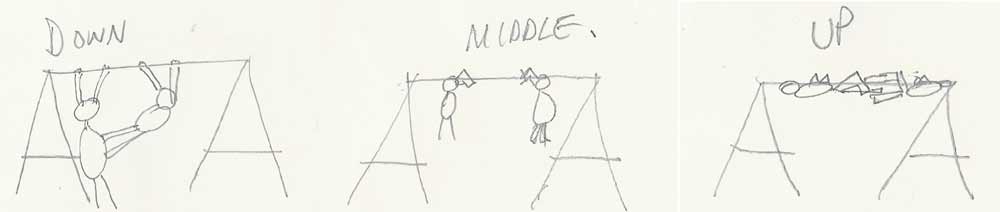
There were tactics involved in this game just like any other – you weighed up your opponent and if you knew his strengths you’d call his weakness. If you disagreed and took too long, the older boys in the queue behind you would get restless and push you on whether you were ready or not. I always chose to go up – my upper body was weak and my legs were strong so I used to cling on to the bar and kick like hell to get to the other side. If you had Cookie behind you, you would always let him go first because if two were fighting on the bars in front of him he’d always launch himself off the bar and clip you with his feet just above the waist, which hurt like hell. He was the Webb Ellis of our playground.
Location – Glanafan, fixed bars in the playground
Personnel – Two teams of an indeterminate number
Equipment – None needed
Action – Swing or shuffle across bars
Aim – To get to the other side
Rules – Cross using one of three ways – up, down or middle – to be agreed with your opponent
Name – We just called it ‘the bars’
I used to play the bars every playtime and lunchtime until the blisters on my hands got too painful. Then it was off to the dab wall – a wall about five metres across with a distinctive red brick line at the height of about 1.5 metres and a drainpipe smack bang in the centre of the wall. The aim of the game was to throw a tennis ball at the wall so that it would hit above the red brick line. The next player had to catch the ball before it bounced four times, otherwise they were eliminated. If a player caught the ball on the full then the thrower was out. We’d usually start with around eight players and the last player won a point. Then we’d start again. Hitting the drainpipe was the key to this game as the ball would more often than not come off at an angle and increase the difficulty for the next player. I would stick at this game until my throwing shoulder got too sore and then head back to the bars.
Location – Glanafan, wall, drainpipe
Personnel – Any number of individual players
Equipment – Tennis ball
Action – Catch and throw the ball
Aim – To get the next player out
Rules – Four bounces maximum, ball thrown above the line, if caught on the full you’re out
Name – Dab
At lunchtime we would occasionally play Mob (name changed to avoid religious repercussions). The Velindre estate was the field of play. You weren’t allowed out of the estate and the school was out of bounds. Two chasers were picked and the rest were runners; the aim of the game was for the chasers to catch the runners, tap them on the head and say 1-2-3-Mob. That runner then became another chaser and the game ended when everyone was caught. We’d usually play with about 50–100 of us and not once did we finish the game.
Location – Velindre Estate
Personnel – Any number of kids
Equipment – None
Action – Running, dodging, chasing and tapping of heads
Aim – To catch others or not to get caught
Rules – Stay in the estate, the school was out of bounds, tap on the head 1-2-3-Mob
Name – Mob
The above three games played at Glanafan are classic examples of games that have evolved through the ingenuity of children. Mob was most likely a game that scouts played and there were probably written rules somewhere, the same for dab but we played this against any wall with any ball except a cricket one. The bars were probably unique and could have been a game developed specifically by the past pupils of Glanafan. There was a lot more going on in my school yard but those were the ones that I played. What defines these games is the location, the personnel, the equipment available, the action, the aim, the rules and the name. It’s not that anyone sat down and thought these things up and committed them to paper before starting the game, we just got on with playing these games. There is one certain element to them though, they each must have started somewhere and evolved into the form of the game that I played.
EXPERIENCE 4 – PAPER CLIP OLYMPICS
So what are the 'paper clip Olympics', I hear you ask. It's a collection of made-up games that are each invented using only the materials available in any given location. Back in the early 1980s my friend Bryan 'Charlie' Cokely and I used to train at soccer together on a local sports field. On the walk to training, to keep ourselves entertained we would challenge each other to make up games from the materials available, which was mostly litter. We invented some really bizarre games and we became so proficient at engineering a contest, we’d boast 'give us a paper clip and a piece of paper and we'll invent an Olympic sport out of it'. So when we invented these different games we’d call them 'paper clip olympic sports’. Then Charlie moved to Australia and went on to a professional soccer career with Sydney City and Woollongong Wolves. I’ve since carried on inventing silly games and have subjected my family to numerous 'paper clip olympic sports’. We have what we call ‘the bag of tricks’, which is full of balls, bats, racquets, frisbees and other throwing things. We’ve taken this bag to the beach and on holidays and we use the equipment inside to create games to play. At the beach we play a made-up game called ‘gate rounders’ and the old favourite, dab. We draw circles in the sand and aim Frisbees and balls in the circles – nearest to the centre wins.
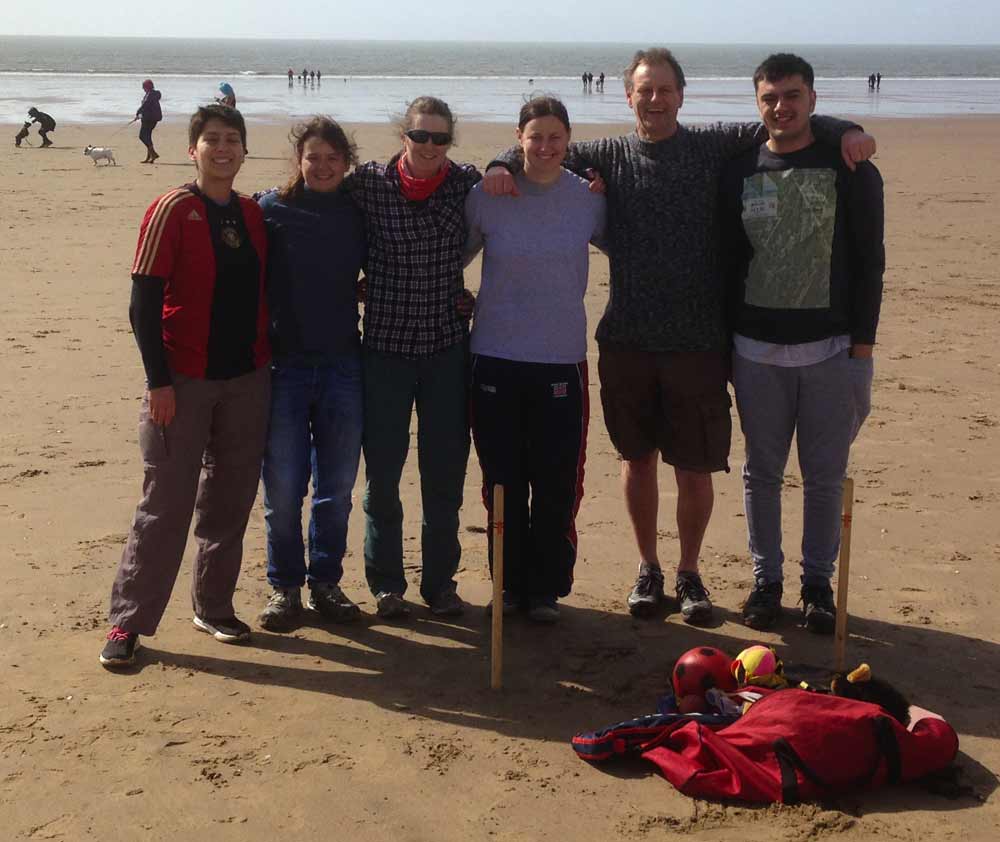
Family & friends prior to the 2016 Gate Rounders World Championship Series on Aberavon Beach with the ‘the bag of tricks’ in the foreground
At different beaches we play different games, the location always dictating what we play. When we are in the countryside we play other games like Melon Boat Racing (where we each design a boat made out of melon rind and sticks and race them down the river) and Best Fallers (competing for the most dramatic and realistic fake fall down a large hill).
I used to coach a swim lane in the mornings in Neath. There was the serious training – we were the first team home in the first ever British Aquathlon Championships (swimming & running race) – but every Friday we’d finish early and play made-up games. I didn’t invent them all, we worked as a team, tried things out, discussed what worked and developed the games that we played. These included underwater walking and float balancing. Everything we played was dictated by the personnel, location & equipment. We developed them further with aims and rules and lastly we gave them a name. In underwater walking, you had to walk on the floor of the pool to the other end. There were unwritten rules: you had to keep at least one foot on the floor at all times. In float balancing you had to stand on a kickboard/float and try to place another one under your feet. If your foot touched the floor of the swimming pool you were out. The person with the most kickboards under them was the winner.
Every game or sport must take place in a location and the nature of the location and the equipment available typically dictate the type of contest . Lastly, please bear with me, it’s my book and I want to include this one. What type of game or sport would you expect to find taking place at a rugby club?
EXPERIENCE 5 – TOUCHY NOSEY
After the 2015 ‘Aberavon Green Stars Rugby Club Annual Round the Pier Swim’, I was socializing in the clubhouse with my triathlon mates Martyn Powell, Chris Price, Nathan Rees, Huw Pascoe & Steve Wilkinson. Martyn now coaches the Neath pool early morning swim session that I mentioned previously and the conversation moved on to the Friday morning games. Someone asked as to how we decided what games we should do and how they come about. I can’t remember my full answer because I’d had a few too many Guinnesses, but to show the boys how easy it was to invent a game we invented one there and then.
Location – Aberavon Green Stars RFC clubhouse – patch of grass outside (near the queue for the burgers)
Personnel – Those previously mentioned – 6 individual players including myself
Equipment – Pint of beer (lager optional) in a glass
Action – To touch your nose with the glass
Aim – To do it as artistically as possible
Rules – You must lift the glass from a position at least below hip level to touch your nose in the most artistic way, with the result of the contest to be decided by a general consensus of opinion by those competing
Name – I put the naming of the game on to Huw Pascoe who called it ‘Touchy Nosey’
The game commenced and I was disqualified in the first round because I forgot to touch my nose with my glass. It is now on record that the first official joint Touchy Nosey World Champions are Huw Pascoe and Chris Price. Pricey was a natural and I’m tipping him to go on to greater things in the future – possibly the first Touchy Nosey professional.
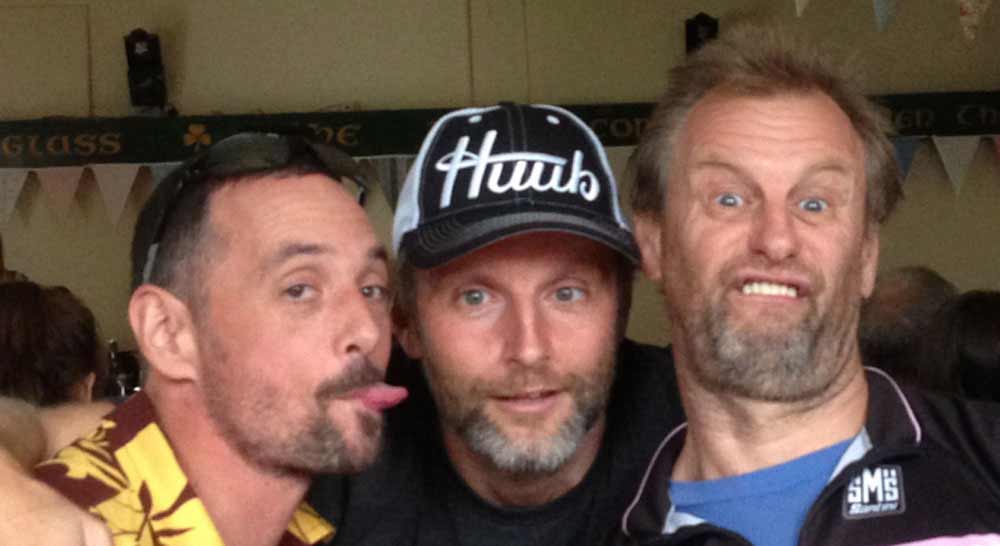
Three of the original Touchy Nosey contestants, Martyn Powell, Chris Price & myself
The TV series ‘It’s a Knockout’ or ‘Jeux Sans Frontières’ is a classic example of game invention. Every week a series of bizarre new active games were invented for the benefit of a European TV audience. Each game was made up of the six ingredients: location (TV set), personnel (competing teams), equipment (various), actions, aims and rules, and each was given a name. Invent a game yourself. If you are in the office, in the lounge or in the kitchen, pick up something light and manœuvrable – a pen, cushion or spoon. Throw it at something immovable, a desk or a chair, or into a saucepan. Try to get it in the centre or as close to the edge as possible; make a mark where it landed with something like a paper clip or a penny piece. Challenge someone else to get it closer. Then add variations – land it at an angle, or do as many as you can in 30 seconds while hopping on one leg with a finger in your ear. Grab more people, split into teams, spell out the person on your left’s name backwards while you are playing. Add rules as you go along and if you have fun, you’ll play again and again and develop the game further and then invent some more. It’s so easy to invent a game.
None of the made-up games in my experiences, either that I have invented or been involved with, will become Olympic or professional sports, they are just examples of how easy it is to invent a game. I’ve never woken up in the morning and said to myself ‘I’m going to invent a new game today’. The games I’ve made up just happened; it’s human nature to be competitive, to be artistic, to be inventive and to have fun. Fun is a key element to new games; it’s what brings players back to them. When you experience something good, the chemical dopamine is released into the brain and the brain is rewarded with a natural high. Other chemicals like endorphins, oxytocin and serotonin are released too and human nature dictates that if you do something and it makes you feel good, you will do it again and again. That’s why games and sports are so great, even if you are not a natural winner, there are so many different opportunities to release those chemicals and reach those highs; you meet new people, you accomplish new goals and you try out new things. Throw a balloon into a room full of people of any age and watch what happens. A game of ‘keep the balloon up’ immediately starts. Most people will join in and every time someone hits the balloon into the air, chemicals are released into their brain as it registers a success. The smiles on the faces of the players are the proof that it’s fun.
Join me to see how we can develop this into a full blown international sport. We’ve thrown a balloon into a room full of people sitting on chairs, picture a school assembly or a theatre audience for example, and they immediately hit the balloon into the air – we have a location, a room, we have personnel, the people in the room, we have equipment, a balloon, we have an action, hitting the balloon, we have an aim, keeping the balloon in the air. Do we have a game? No, what we have is play. No-one is keeping score because there are no rules. Split the room in half and draw a line down the middle, with half of the people on side A and half on side B. We tell both teams that they have to knock the balloon into the other half of the room and that the team that has the balloon in their half for the least amount of time is the winner. We both have a stopwatch; I’m timing side A and you’re timing side B. We start our watches when the balloon crosses the line and enters our side and we stop it when the balloon crosses the line on the way back to the other side. We now have a rule and we have a game, so let’s give it a name. I think we’ll call it ‘booonce’ (the emphasis is on the ‘ooo’, it actually sounds like seven or eight ‘o’s, like booooooooonce).
Good, now that we’ve got the name straight, the people in the room get on with playing the game. Because they are so close to the line, they hit each other instead of the balloon and so we spread the chairs apart or vacate a couple of rows if they’re fixed, and draw a two metre wide corridor between the two teams with a piece of chalk. They seem to be having more fun when the balloon is in the air for longer between hits, so to keep the balloon up higher for longer we introduce a net in the middle, which leads to more smiles and more happiness. At the end of the contest, your partner and kids were in the winning team and they had FUN, so when you all got home they posted videos on Facebook and Youtube. Friends and other people clicked on the videos and saw how much fun they were all having and asked as to how the game was played. Your partner wrote the rules down on Facebook.
Six months later your local supermarket has sold out of balloons because the local schools, scout and guide groups, churches and even pubs have started playing booonce. A local league is formed in your town and within two years the whole of the UK is playing. Some teams and leagues have changed the rules to suit their playing area so several teams get together to form the UK Booonce Association to regulate play. This covers the game in the UK, which is now booming more than ever, and teams are coming over from Europe to play. The Deutsche Booonce Federation has slightly different rules so a meeting between all of the booonce playing countries is called and the International Booonce Union is born. Taylor Swift includes a game of booonce in her latest music video and it has a trillion hits on Youtube. Participation in the game increases ten fold and within six years nearly every country in the world has its own booonce federation. The sport is applying for Olympic recognition and you’ve never played the game because you are still holding the stopwatch. Your partner and kids are international celebrities with their own trading card sets and merchandise deals. Well, someone has to make sacrifices, and don’t forget I’m holding the other watch, I’ve made sacrifices too. On the bright side at least your watch still works.
Let’s look at the evolution of the game ‘booonce’ from its birth to becoming an international sport. 0 means that we have nothing.
1. Location = 0
2. Location + personnel = 0
3. Location + personnel + equipment = 0
4. Location + personnel + equipment + action = play
5. Location + personnel + equipment + action + aim = play
6. Location + personnel + equipment + action + aim + verbal rules = game
7. Location + personnel + equipment + action + aim + written rules = organized game
8. Location + personnel + equipment + action + aim + written rules + governing body = sport
9. Location + personnel + equipment + action + aim + written rules + national governing body = national sport
10. Location + personnel + equipment + action + aim + written rules + world governing body = international sport
Looking at the above equations I think it’s safe to say that a game is born at step 6 and a sport at step 8. The above 10 phases can be split into three distinct groups.
Group 1 (1–3) – Physical basics – The location, people and equipment are physical entities, they are tangible; we can reach out and touch them.
Group 2 (4–6) – Variants – The actions, aims and verbal rules. They are variable and when changed they will usually help a sport to evolve and will enhance the playing experience of the participants. These are the three main ingredients of a game or sport and are what makes each individual sport unique. Actions, aims and verbal rules are not physical entities and unless they are recorded they will only exist in the memories of the players or spectators.
Group 3 (7–10) – Organisation – This is where a sport gets serious, the rules are written down and governing bodies are formed.
Think back to the spectacular. What if you chose handball but your support team couldn’t find the handball goals or ball? You sent them back in and they turned up with the Association football goals and ball. They took forever just to do that, so rather than send them back in again we used the Association football equipment and improvised in order to play handball. We could do this because they are similar and with our adapted equipment and our one on one rules we could play a full game of one on one handball. Let’s look at how things changed with respect to the six ingredients compared to when we were actually playing Association football. Group 1, there’s no change in the physical basics. We are in the same location, we are the same people and we used the same equipment. In group 2 we see changes. Different actions – we are throwing the ball instead of kicking it – different aims – the aim is now to throw the ball into the net to score a goal and different rules, which we would have adapted and changed from team handball. In this instance the differences between the sports of Association football and handball are all found within group 2 of the ingredients. Group 1 remains unchanged and group 3 is irrelevant.
THE BEGINNING OF A SPORT
Let’s return to Shearman and Marshall, who I believe were attempting to imitate Charles Darwin’s Origin of the Species. The evolution of a sport is not like Darwin’s theories; the evolution of man is a serious business. In our evolution, something has to exist before something else can – DNA (46 chromosomes) – and we can trace ours back in time. The evolution of a game or sport is not like that of man, there are no fossils of the ancient games that used to exist, you can’t go digging up a goal scored in folk football games like harpastum or cnappan. You can dig up the people who played it, and possibly some of the equipment that was used if it hasn’t perished (group 1) and the rules may even be written down somewhere (group 3), but the game itself, its variants, the aims and actions of the players and the verbal rules (group 2) no longer exist.
That’s one of the reasons why we spent the night together. We checked after we had finished the games that everything was the same as it was before we started playing. Group 1 of the above list did not change because nothing got broken and group 2 no longer exists because the ingredients in that group only belong in the present. However, because we’ve written about the spectacular it now exists in a historical context, but if we hadn’t have written about it the memory of it would eventually have faded away and when we’re both pushing up the daisies there would have been no recollection of this information. That’s why it is so difficult to pinpoint the origins of a sport that is born, because at the time, the people playing it did not record their efforts.
Earlier on we decided that the origin of a game or sport is the point at which it becomes a single entity. How can we relate this to our two forms of origin: creation and birth?
CREATION – A game/sport that has a parent or contributory game/sport can only find its origin by creation if the contributory game/sport has reached at least stage 6 of the above progression. Rugby League was born at stage 9 of its parent sport’s progression and triathlon was born at stage 10 of its three contributory sports’ progressions.
BIRTH – This is harder to define. Arguably it could be at stage 6 when it becomes a recognizable game but I believe it may be possible that it could be at stage 5 when an aim is introduced. Booonce was certainly only recognizable when it had reached stage six but I think that this is a definite grey area that needs to be explored in greater detail.
EVOLUTION OF A SPORT
We have decided that a game/sport is made up of six ingredients and as a rule these never stay the same from the beginning of when a game/sport is first played to how it is played today. The people who play and organize games and sport are always looking for a greater or a safer experience to enhance its appeal and to keep the participants interested. So how and why does a game/sport evolve? There are two major reasons as to why:
1. To solve any problems that occur.
2. To take opportunities to enhance the game/sport wherever possible.
Changes in rules will usually be made to cater for one of the above. In the sport booonce we introduced the two metre gap between the teams to solve the problem of players hitting each other and we then introduced the net to enhance the game for the players. Sports are evolving constantly. The sport of Rugby Union has seen many changes in the laws relating to the scrum, in particular the binding of prop forwards. These have mostly been changed for safety reasons. The collapsing of a scrum can lead to neck injuries for players and these laws are attempting to solve that problem. The tip tackle law is another that has attempted to solve the problem of too many injuries. The law that allowed players to throw a line-out ball further back than the actual exit point where the ball went into touch was an enhancement to the game. Players can now restart the game themselves or throw the ball to a team mate, speeding up the game and introducing running in broken play, which is a much greater spectacle for players and spectators alike. If you are not familiar with the sport of Rugby Union, then look to your own sport and ask yourself the following two questions in relation to a law change:
1. Did the change solve a problem?
2. Did it make the sport better?
If you can’t answer yes to one or both of the above questions then you need to select other lawmakers to the governing body of your sport.
If you’ve arrived at this point and you are scratching your head and thinking ‘what is this bloke on about?’ Or you’ve read through and nothing has seemed remotely interesting, then you need to get practical. I bet you skipped the ‘invent a game now’ opportunity. It’s redemption time. Don’t move on until you’ve invented a game. Go to the shop and buy some balloons, blow them up, clear your mind and focus on the balloons, focus on the actions that you can do with them and make up some aims; relax and focus. If you can’t find balloons then go to the bathroom or kitchen and use sponges instead, or cushions. It’s always best to use something soft when you are creating a game, trust me on that one – I learnt the ‘hard’ way. Focus on actions and aims first and then create a rule. You’ve invented a game, now let’s move on.
SUMMARY – We now have definitions of what play is and what games and sports are and we know when play becomes a game, and when a game becomes a sport. We have decided that there are six common ingredients to every game and sport: location, personnel, equipment (optional), actions, aims and rules. Everything within a game/sport fits into one of these categories. It is very easy to invent a game by combining these six ingredients. An international sport that is born has a progression of ten steps that can be used to identify the status of the sport along its line of evolution. There are three distinct groupings along this pathway: physical basics, variants and organisation. The origin of a game/sport that is born would most likely be identifiable as being the point at which it reaches step 5 (introduction of an aim) or step 6 (addition of a rule). A game/sport will continue to evolve, as driven by the need or want to solve problems or enhance the playing experience.
CONCLUSION – It is very easy to invent a game and there are common denominators in games and sports that can be used to help identify the origin of a sport.
FOOTNOTE – Now that we have a set of common components for a game/sport and a set of definitions & rules that govern the origin of a game/sport, we can look at the origin of Rugby Union and decide where this lies. To the tune of Elvis’ ‘Blue Suede Shoes’…
It’s one for the location
Two for who you know
Three for the equipment
Let’s go go go……………..
But don’t you
call it a game without rules
A ha haaaa
You can call it anything
But it’s not a game without rules
A ha haaaa
|