| AIM – The aim of this chapter is to include additional information about the 1897 Old Rugbeian Society report. We need to look more closely at the report and keep asking questions, because as far as I’m concerned it deliberately set out to misinform and there are several inconsistencies within the report that require investigation. Let’s start with the letters contained within the report and begin with Thomas Hughes. To quote directly from the report: “The late Judge Hughes, so well known as the author of “Tom Brown’s School Days,” writing from Uffington House, Chester, under the date of 14th March, 1895, characteristically replied as follows: Dear Sir Your Committee have raised an old and warmly debated question of half a century back.” – ORSR011 Thomas Hughes starts his letter dated 14 March 1895 by referring to ‘Your Committee’. The front cover of the report however states “Report (with appendices) of the sub-committee of the Old Rugbeian Society appointed in July 1895”: 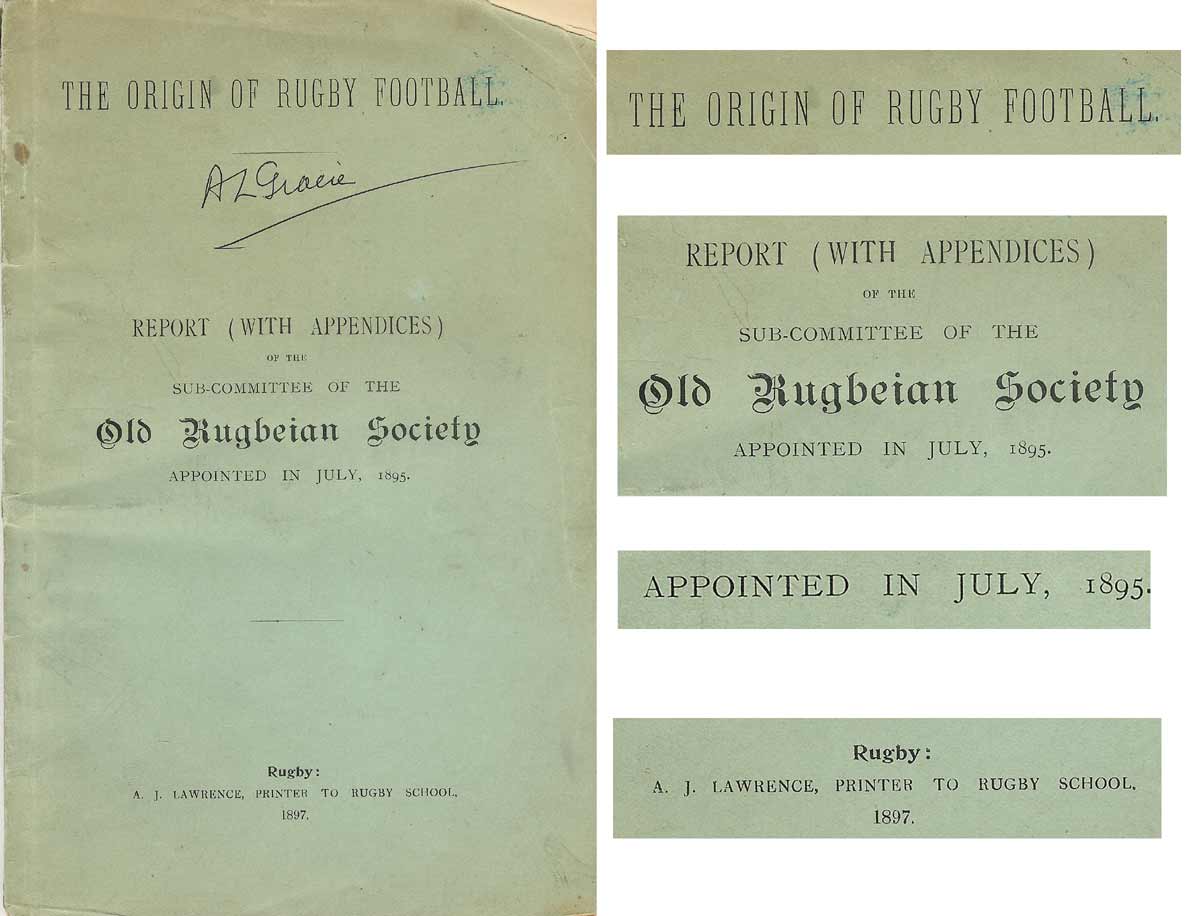
The front cover of the 1897 report How can Thomas Hughes have replied to a letter from a committee that had not yet been appointed? He wrote the letter in March to a committee that wasn’t convened until four months later, in July. Just in case you think that it might have been a slip of the pen, what about his second letter, dated 18 March, which ends “All success to the Committee, of whose existence I am glad to know.” – ORSR014 It seems from the report that the majority of letters were written before the sub-committee had formed. 14 & 18 March 1895 – Thomas Hughes (died 22 March 1896) 22 March 1895 – Henry H. Gibbs (died 13 September 1907) 24 March 1895 – John R. Lyon 24 March 1895 – F. Lushington 8 May 1895 – R.W. son of Peregrine Birch 8 May 1895 – J. W. Cunningham 11 May 1895 – Henry Homer (died 16 October 1911) 13 May 1895 – Thomas Harris (died 2 August 1895) 16 May 1895 – George Chas Benn (died before publication) 23 May 1895 – Samuel Garratt 25 May 1895 – Thomas Harris (died 2nd August 1895) 6 June 1895 – R.W. son of Peregrine Birch July 1895 – Sub-committee appointed 11 November 1895 – H.G. Allen 12 November 1895 – John Coke Fowler 25 February 1896 – F. Lushington 1 February 1897 – Alex J. Arbuthnot 17 February 1897 – F. H. Deane 4 May 1897 – Canon H. R. Nevill of Norwich circa July 1897 – Report printed During my research I struggled to understand how this could have been, and was also concerned about the deaths of a number of the above letter writers, including Thomas Hughes and George Chas Benn, between the date that the letter was written and the date of its publication. The most significant of these is Thomas Harris; I’ll quote directly from the report: “… in the person of the Rev. T Harris, brother of Mr E Harris the solicitor at Rugby, who have both died within the last two years. From him, through the kindness of his friend, the Rev. H. Homer, the following exceedingly interesting particulars were obtained, affording a remarkable corroboration of Mr. Bloxam’s statements. We print Mr. Homer’s letter first…” – ORSR019 I thought it wise to check out the original correspondence at the Rugby School library and I arrived with a list of letters from six correspondents that I’d identified as needing closer inspection. There were no envelopes accompanying any of the letters and whilst I was expecting this and the lack of envelopes does not signify anything untoward, the sight of an envelope with a dated postmark would have been welcomed. There weren’t any original enquiry letters either, which I found unusual. It would have been nice to have seen the questions asked, alongside any information that had been volunteered with the questions. The original correspondence is bound into a volume and a welcome addition to the collection is a series of letters from Morris Davies, the Old Rugbeian Society secretary to Mr H.F. Wilson, one of the compilers of the report. This series of letters was helpful in identifying why some of the responses pre-dated the formation of the sub-committee. I believe this series of letters to be important and worth recording and I have therefore included them in the following chapter. With information from these letters at hand, we are able to continue answering questions like: WHO WROTE THE REPORT? The sub-committee was made up of Henry Francis Wilson – barrister; Herbert Henry Child – barrister; Arthur George Guillemard – solicitor; Harry Lushington Stephen – barrister. From the additional correspondence between Davies and Wilson it becomes apparent that H.F. Wilson was the early driving force behind the report. His first contact was with every schoolboy’s hero, Thomas Hughes, who wrote what I suspect was his favourite book, ‘Tom Brown’s Schooldays’. The committee that Hughes refers to in his letters was probably the Old Rugbeian Society committee, which I’ve assumed included Wilson. Hughes’ reply suggests that Wilson had approached him in an official capacity on behalf of the committee. Wilson followed a line of enquiry suggested by Hughes, but it soon dried up. This clears up the problem with the dates – Wilson started the investigations as a member of the ORS committee in March 1895. It seems that Wilson worked alone, but then drafted a report that he forwarded to Morris Davies, the ORS secretary. In a letter dated 9 May 1895, Davies says “I have left your draft report with Mr Benn”. Davies had contacted Benn & Homer and the latter wrote to Thomas Harris. Davies was delighted with Harris’ first letter and it seems that at that point the responsibility for the report shifted. Davies assumed seniority and relentlessly pushed Wilson to write and gain more information from Harris. In between letters dated 20 May and 30 May, it seems that Wilson received a reply from Harris that was not to Davies’ liking; in the letter dated 30 May Davies pushed Wilson to contact Harris again, stressing the importance of the committee’s mission: “Dear Mr Wilson, - I wonder if Mr. Harris thoroughly understands what we are at. Did you explain to him that there was a tradition, &c. to be found in Bloxam’s book, and all that we wanted was some corroboration (which we hoped he could give), of the statement that Webb-Ellis was the first to run with the ball. It is not for me to suggest what you should do, but I should again press him to say what he knows about it. He must remember our hero doing something unusual” – (see Chapter 13) Between 4 June and 31 July, Davies, who was still holding Wilson’s draft report, called a meeting of the Old Rugbeian Society at which the sub-committee was formed. Unfortunately Wilson was unable to attend and the last letter in the series between Davies and Wilson, dated 6 August, informs Wilson of the sub-committee’s confidence in him “No-one thought you faithless, I explained how it was you could not turn up, and all were satisfied”. The letter goes on to inform Wilson that he had been elected to a vacant post on the sub-committee and then waves his singular involvement goodbye with a vote of thanks “for all he had done in re W. Webb-Ellis.” Morris Davies also added his personal gratitude “As an O.R. I sincerely thank you for the trouble you have taken.” The letter also informed him that “I left your report with Guillemard”. So on 6 August 1895 we know that a sub-committee had been formed to wrest the ownership of the report from Wilson and that the report was at that point in the hands of Arthur George Guillemard. 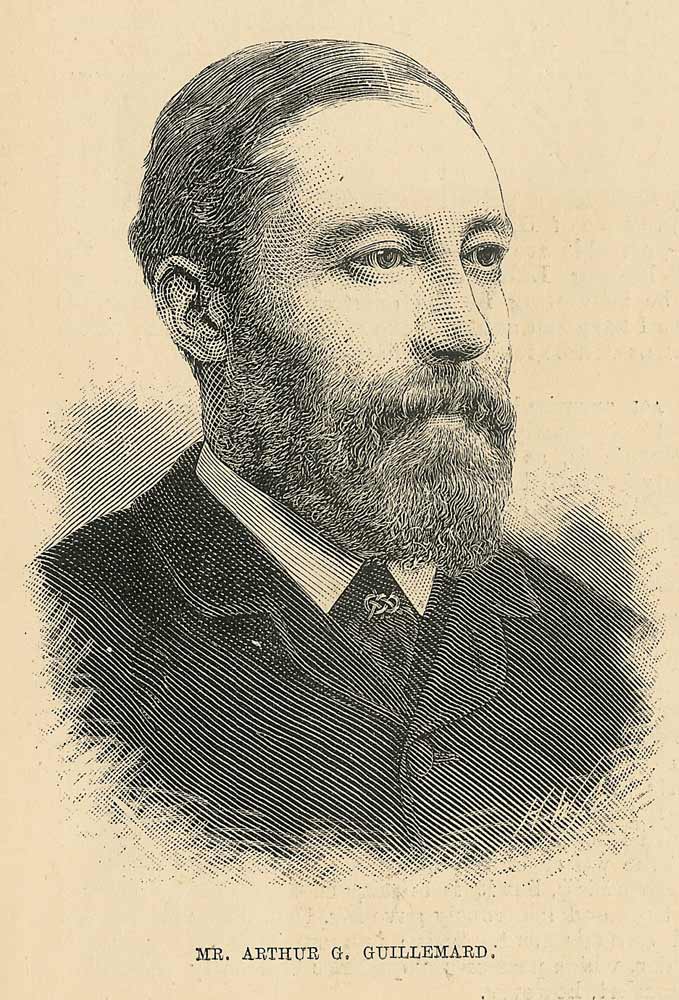
Arthur George Guillemard. My opinion is that Guillemard wrote the booklet ‘The Origin of Rugby Football’. He was a seasoned writer of some repute, having written chapters in Marshall’s book. He had attended the school 1859–1864 while the three barristers had all been contemporaries in the early 1870s. Guillemard was older and of far greater seniority in Rugby Union circles than the other three. He was also a solicitor who was used to instructing barristers. Once the sub-committee was formed, being the senior member, he took over from Wilson as the report editor. Just to be on the safe side let’s read through the text to see who is mentioned where: H.L. Stephen – In a footnote on page four, about folk football it states that “Mr H. L. Stephen points out that by the Highway Act, 1835…” (ORSR004), so it can’t have been H.L. Stephen writing the report. H.H. Child – In a footnote on page eight (ORSR008) it states that H.H. Child had looked up the original 1880 Times article that Bloxam referred to in his Meteor article (we’ve published this to www.world-rugby-museum.com if you would like to read it), so it can’t have been H.H. Child writing the report. H.F. Wilson – He was responsible for the onerous work of writing the draft report, but as we can see from the Davies–Wilson correspondence, the report was taken out of his hands and placed into Guillemard’s. A.G. Guillemard – The first mention of A.G. Guillemard by name in the report is among the final credits. If he had had another involvement, for example in writing letters or doing research, it would have been mentioned in the text. Whilst Guillemard is only mentioned by name once, he can also be found in the report itself. If you cast your mind back to the following paragraph that mentions the Standard in 1876: “He had previously broached the subject, as he tells us in a letter headed “Football and Athletics” to the Meteor (No 104), of October 10, 1876, by writing to the Standard (in which a discussion on the game had been taking place) to controvert the belief, expressed by one of its correspondents that the Rugby game, at present played at Rugby, was ‘of great and unknown antiquity.’” – ORSR011 In which “one of its correspondents” just so happened to be Arthur George Guillemard. To gain a better idea of the validity of Guillemard’s writing, let’s hop into a taxi, ‘Back to the Future’ style, and have a look at the London Evening Standard chain of letters from its beginning. 
All aboard for the London Evening Standard of 10 February 1876… “FATAL FOOTBALL ACCIDENT. – An inquest was held at Manchester, on Tuesday, on the body of a young man named Ison, who died on Sunday from compression of the brain, produced by injuries sustained in a football match on Saturday. Deceased, while running after the ball, was charged by one of the opposing team and knocked down. He had to be removed in a cab, and shortly afterwards became unconscious. The jury returned a verdict of Accidental Death, and strongly recommended that “charging,” “scrimmaging,” “butting,” and catching by the legs should be abolished in the game of football.” – LEVS18760210 This report enraged Edward B. Adams M.R.C.S., a surgeon who had had enough of dealing with football injuries. He made a call for inexperienced players to be stopped from playing football by the authorities. This letter was published on 12 February. “FOOTBALL. TO THE EDITOR OF THE STANDARD. SIR,–In your paper of this date I read the following melancholy statement: An inquest was held at Manchester on Tuesday, on Mr. Ison, who died on Sunday from compression of the brain, produced by injuries sustained in a football match on Saturday. Deceased while running after the ball was charged by one of the opposite team, and knocked down. Verdict of the jury in accordance with the evidence and common sense. Being acquainted with the fact, as a medical man of some 26 years standing, of broken legs, fractured clavicles, injured spines, ruptures by over exertion, necrosis of the bones of the leg from blows or kicks, fractures of the ankle joint and leg, injuries to the hip-joint, with many other serious results to the development of young men engaged in this rufflianly pastime, surely a stop should at once be exercised by those in authority over the inexperienced who indulge in such wanton ruffianism as the game of football.–I remain, yours obediently, EDWARD B. ADAMS, M.R.C.S England. Bungay, Suffolk, Feb. 10.” – LEVS18760212 ‘Headmaster’ replied and his letter was published on 16 February. In it he points out that Mr Ison lost his life playing the “modern degenerate sport” that is Rugby Union and not football as played at Eton, Harrow, Winchester & Westminster, which are the ‘oldest, manliest and best of games’. “FOOTBALL. TO THE EDITOR OF THE STANDARD. SIR,–Mr. Adams has written strongly against the game of football from a medical point of view. As an old public school man and a schoolmaster, I should be very sorry to see the game – as played at Eton, Harrow, Winchester, or Westminster – forbidden by any authority. It is one of the oldest, manliest, and best of games. It is more ancient than cricket, the foremost of national sports. The game through which Mr. Ison lost his life is not football properly so called – it is the game known as the “Rugby Union,” and is a modification or adaptation of the Rugby School (so called) football. Persons in authority cannot do better than discourage by all means in their power this modern degenerate sport, and promote the famous, healthy, scientific, ancient, and national game of football, as played at Harrow or by “association” clubs. The popularity of the “Rugby Union” game is of very recent date: it is due to various causes, which I have no time to discuss. I see no immediate prospect of checking it, except by the influence of a sound public opinion upon the authorities of schools, such as Rugby, Marlborough, Clifton, and Wellington. If at these schools it were forbidden it would gradually decline.–Your obedient servant, HEADMASTER. Feb. 12.” – LEVS18760216 A response to Headmaster’s letter by a supporter of the Rugby Union game, the then secretary of the Rugby Football Union, Arthur George Guillemard, was published on 18 February. “FOOTBALL. TO THE EDITOR OF THE STANDARD. SIR,–Some of the statements of your correspondent “Headmaster” are so completely at variance with facts that I trust you will allow me space briefly to reply to his letter. Firstly, he avers that the game of football as played by Rugby Union laws is not football properly so called. What ”football properly so called” is he does not explain ; the fact remains that the earliest records of football matches show clearly that the game was played according to the Rugby system–namely, that its distinguishing feature lay in running with the ball. It may also be a fact of which “Headmaster” is ignorant that Rugby School was celebrated for its football many decades before the game was even taken up by Eton, Harrow, Winchester or Westminster. The Rugby game, therefore, as compared with that played at Harrow or by association clubs can hardly be called a “modern sport,” and I am happy to say that its popularity is far too wide-spread to be affected by the unfounded statements of “Headmaster.” He may also be surprised to hear that the accidents resulting from Rugby football are not only less numerous in proportion to the numbers playing than those resulting from the association game, but also less numerous than those that occur at any other British sport or athletic pastime. It would be well if “Headmaster” would turn his attention to the perils of rink-skating, for more accidents have happened to rink-skaters in the past three months, than to Rugby football players in three years. “Headmaster” is evidently unacquainted with the fact that the practices that have been complained of in the old Rugby School game have been done away with by the Rugby Union code, and much as the recent accident will be deplored by football players generally, the prestige of a game which has spread to Canada and India, Australia and New Zealand, and affords healthful exercise to some thirty thousand players in our own islands, is not likely to be seriously affected by the strictures of one or two individuals, who are not acquainted with the facts of the case in point.– Yours faithfully, ARTHUR G. GUILLEMARD, Hon. Sec. Rugby Football Union, Eltham, Feb. 16.” – LEVS18760218 Guillemard makes several unfounded statements that in the 1870s could not be backed up by facts or figures and so must therefore have been fabricated. For instance, he says: “…earliest records of football show clearly that the game was played according to the Rugby system…” “…Rugby School was celebrated for its football many decades before the game was even taken up by Eton, Harrow, Winchester or Westminster.” “He may also be surprised to hear that the accidents resulting from Rugby football are not only less numerous in proportion to the numbers playing than those resulting from the association game, but also less numerous than those that occur at any other British sport or athletic pastime.” “It would be well if “Headmaster” would turn his attention to the perils of rink-skating, for more accidents have happened to rink-skaters in the past three months, than to Rugby football players in three years.” Public Schoolman entered the debate on the same day, 18 February, and his letter was in support of Headmaster. He was an ex-public schoolboy who witnessed a ‘Rugby Rules’ game where a boy’s leg was broken deliberately by a large man. It’s not worth printing his letter here as there is nothing else of importance in it. Our main players here are Headmaster, Guillemard and Bloxam, who has yet to join in. Headmaster responded to Guillemard’s unsupported claims in a letter printed on 21 February, asking him to supply documentary evidence to prove his point. He also challenged his statement on the proportion of accidents within the two sports (Association & Rugby), again asking for evidence. He also called into question that the Rugby Rules allowed running with the ball. “FOOTBALL. TO THE EDITOR OF THE STANDARD. SIR,–I am glad that so stout a champion of the Rugby game as Mr. Guillemard has replied to my letter. I maintain still, until Mr. Guillemard refers me to undoubted historical testimony assorting the contrary, that the Rugby game is not the old game, as played in England before the school of Rugby was founded. He says “Rugby School was celebrated for its football many decades of years before the game was even taken up at Eton, Harrow, Winchester or Westminster.” Now, unless my memory is at fault, Rugby school has not existed “many decades of years,” whereas Winchester was founded in 1385, and Eton about 50 years later. Unless Mr. Guillemard can refer us to documents showing beyond question that the game, as played on English and Scotch commons, and played too, sometimes by women, was not adopted at the ancient public schools, or any football played there, until the comparatively modern school of Rugby invented their game, he will hardly establish his point in the minds of your readers. I define football to be a game in which the ball is propelled by the feet towards a certain goal, and where the hands are used as little as possible. I refuse to believe, against the evidence of my senses, against the testimony of medical men, against the corroborative opinions of competent and impartial persons whom I have consulted, that the Association game causes more serious accidents than the Rugby Union. Upon this we want statistics, not assertions on either side. It has been for years known to me that certain objectionable practices in the old Rugby game have been repealed in the new Rugby Union code of rules; but, au contraire, an old Rugbeian informs me that 25 years ago, or less, no player at Rugby could take the ball into his hands unless it were bounding, and that “passing on” from one to another was forbidden. He adds that in his opinion these practices are most objectionable. Many persons are at a loss to conceive what can be the great popularity of this game. When I watch it occasionally, about two thirds of the time is taken up in scrimmages; a drearier sight it is hard to imagine. I have made it my business to discover why so many people of the lower orders look on at it in our public parks, and their remarks have conclusively proved to me that what they most enjoy is not a clever kick but an ugly fall. It appeals, I fear, to the ruder and more cruel instincts of human nature among these uneducated or half-uneducated people. One of the best of our Rugby “half-backs” admitted the other day, with great frankness, that there was little fun in the game for those whose played “up.” Surely a game worth preserving should spread its excitement, and interest and skill over more than a small fraction of the combatants. The true and manly game of football is a sport wholly distinct from the Rugby hand ball. One of our new boys put it very well the other day, when he asked a master whether we “played Rugby or football at our school.” Sir, I apologise for making my remarks so long; but for the youth and future men of England this is a very important subject. My opinions have not been hastily formed; they are the same as they were when I was at Winchester more than 20 years ago–namely, that the Rugby Union game is unmanly, unscientific, too rough for most boys, too dangerous for all men; that it is no more to be compared to true football than battledore and shuttle-cock to tennis, or trap bat to cricket; that its popularity is on all grounds to be deplored, and greatly on this–that very few but the sons of gentlemen, for example, at Rugby, Marlborough, or the Universities, can indulge in it without a lowering effect on their disposition, and an ungentle influence on their lives.–Your obedient servant, HEADMASTER, London, Feb. 18.” – LEVS18760221 In a letter published on 24 February, Guillemard admits to his lack of statistics but pushes the folk football games as being the origin of Rugby Union. “FOOTBALL. TO THE EDITOR OF THE STANDARD. SIR,–“Headmaster” seems anxious to obtain more information regarding the early history of football than can be gleaned from a whole library of cyclopædias. It is not very difficult to go back to the Roman Harpastum, about which Pollux says, “The players divided themselves into two bands, and at the two ends, behind the places where the players were stationed, there were two lines (goal lines), beyond which they tried to carry the ball–a feat that could not be accomplished without pushing one another backwards and forwards.” As Mr. Alcock remarks in his “Football, our Winter Game,” it does not show any great credulity to assume that this rough sport was introduced into Britain by the Romans, and there is good reason to believe that it was the parent of English Football. At any rate there were goals and two sides of players who had to drive the ball from the end to end of a strip of ground. Probably the earliest record of a football match in Great Britain is that given by Sir T. Morton Eden, in his “Statistical Account of Scotland,” with reference to the great annual game at the Cross of Scone, played by the bachelors and married men of the parish on Shrove Tuesday. “The game was this–he who at any time got the ball into his hands ran with it till he was overtaken by a player of the opposite party, and then if he could shake himself loose from those who were holding him, he ran on; if not, he threw the ball from him, unless it was wrested from him by one of the other party; but no person was allowed to kick it.” The goals were a river at one end of the ground and a hole on the moor at the other. And as to football as played in the earliest times on our village commons, the players were at liberty to carry the ball or kick it as they pleased. So that if “Headmaster” wishes to trace the game back to the fountain head I may repeat that “the earliest records of football matches show clearly that the game was played according to the Rugby system–namely, that its distinguishing feature lay in running with the ball.” With football, as with cricket, I think there can be little doubt that until a comparatively recent period rules, if, indeed, as regards football, any at all existed, were of the very crudest description. And although I admit the older standing of Eton and Winchester, and that an Etonian and Wykhamist may have kicked a football before ever a Rugbeian was born, still, on the other hand, the public will agree that first of all schools, Rugby made herself a name by her football rules. And I may here be allowed to deprecate “Headmaster’s” statement that “Rugby School has not existed many decades of years:” it was founded by a good old grocer, one Lawrence Sherriffe, in 1573, and, as it has celebrated its tercentenary, can hardly be termed “a comparatively modern school.” I am glad to ascertain “Headmaster’s” definition of football, especially as it exactly coincides with my expectations. He is of opinion that the hands should be brought into play as little as possible: in fact, that carrying the ball is not football. This is of all arguments the most hackneyed, and has been met twenty times in as many different journals. In the earliest times was a name fixed upon and then a game established in accordance with it? Why should the name exercise an arbitrary authority over the rules, and if (as is the case) the large majority of football players consider the game improved by carrying, why should the fact that nothing relating to it can be inferred from the name prevent their adoption of the practice? Like “Headmaster’s” as regards the Association rules, I have no detailed statistics as to accidents at the Rugby game, but can only say that, as far as I can remember, only three serious accidents occurred in the matches in which I myself took part during fourteen football seasons at Rugby and round London, and I may reiterate that so small a proportion of accidents would not have occurred at any other English out-door pastime. And, finally, “Headmaster’s” isolated instances of players who are dissatisfied with the Rugby game prove nothing whatever, when even an inveterate opponent like himself cannot help admitting its great and general popularity. The crack Rugby half back who thought there was very little fun in playing forward is a mere counterpart of the crack bowler in the eleven who cannot see much pleasure in fielding at short leg. Two out of three football players are forward players, so surely the game has attractions for more than a small fraction of the combatants. If “Headmaster” is of opinion that a drearier sight than Rugby football match it is hard to imagine, by all means let him feast his eyes on an Association game: but when he proceeds to stigmatise the favourite English winter game as “unmanly and unscientific,” and having a lowering effect on the disposition and an ungentle influence on the lives of many players, he descends to a crushing condemnation of a healthful sport, which it would be absurd for me to criticise, and in which he will be supported by no single person who has had any practical experience of Rugby football.–Yours faithfully, ARTHUR G. GUILLEMARD. Hon. Sec. Rugby Football Union. Eltham, Feb. 22.” – LEVS18760224 Enter Matthew Holbeche Bloxam, corresponding with the Standard “to controvert the belief by one of its correspondents” (as phrased by the ORS Report – OSRS011) and to set the record straight with regards to the practice of ‘running with the ball’. This letter was published on 26 February 1876. “FOOTBALL. TO THE EDITOR OF THE STANDARD. SIR,–Permit an old Rugbeian, at school under the headmastership of Dr. Wooll, who resigned that office in the summer of 1828, to say a few words on the point in controversy in the present Rugby game. The running with the ball in one’s hands is of no great antiquity as regards Rugby, it has there originated within the last half-century. It was not so during Dr. Wooll’s mastership. When a boy had caught the ball in his hands he was not allowed to run forwards with it, but marking with the heel of his foot the spot where he had caught it, he was permitted without molestation to go back on his own side as far as he chose, the opposite side not being allowed to cross the point where the ball had been caught. He who had caught the ball might then either punt it, or place it on the ground and kick it, or allow some one else on his side to kick it so placed; but directly the ball touched the ground, the opposite side might rush forward and contend. Such was the rule of the game at Rugby School fifty years ago. MATTHEW HOLBECHE BLOXAM, at Rugby School from 1813 to 1821, and ever since a resident at Rugby. Feb. 24.” – LEVS18760226 And so the series of letters to the London Evening Standard ended with Guillemard being a driving force for folk football being the origin of Rugby Union – “So that if “Headmaster” wishes to trace the game back to the fountain head I may repeat that “the earliest records of football matches show clearly that the game was played according to the Rugby system – namely, that its distinguishing features lay in running with the ball.” With respect to the 1897 ‘Origin of Rugby Football’ report, we can assume that after Wilson was relieved of the duty of writing it, the responsibility then passed to Arthur G Guillemard because of his service to the Rugby Football Union, his authorship of Marshall’s chapters, his writing of letters to the newspapers and his senior position within the Rugby fraternity. The Davies–Wilson letters have however thrown up another question. Was Morris Davies secretly the leader and the real driving force behind ‘the plaque in the wall gang’? Did he initially detail Wilson to compile the report and when he became dissatisfied with Wilson’s handling of Thomas Harris, organise the sub-committee takeover, making sure that the report passed into the hands of his old and trusted friend Arthur Guillemard? It seems that the plaque in the wall was his idea, put forward in a letter dated 6 August 1895. This was two years before the investigation was concluded and the report was published. Davies had already decided its outcome: Webb Ellis was a hero and he already knew where the ‘granite slab’ was to be placed. 6 August 1895 – “I would again suggest that we place a handsome granite slab (with inscription, of course) in the Headmaster’s wall, exactly opposite the centre of the school goal, to commemorate our hero’s invention. Of course you can do what you like, but I believe that idea is as sensible as any. Yours sincerely, MORRIS DAVIES.” (see chapter 13) To our original four members of the ‘plaque in the wall gang’ – Wilson, Child, Stephen and Guillemard – we must now add Morris Davies. These five Old Rugbeians, Davies in particular, are guilty of having perverted the course of history. When they named Webb Ellis as the inventor of Rugby Union and laid the plaque in the headmaster’s wall, the true originators of the sport, the pupils who decided that the goal was above the crossbar missed out, it was they who deserve the acclaim that Webb Ellis received. It is they who are the true inventors of Rugby Union and they deserve to be recognized as such. SUMMARY – If the report was intended to be an unbiased review of the origin of Rugby Football, it had no chance. The report had one purpose and that was to place the origin of Rugby Football at Rugby School. Two years before its publication, Morris Davies, the secretary of the ORS, had already decided that Webb Ellis was a hero and that a plaque saying so should be cemented into the headmaster’s wall at Rugby School. In forming a sub-committee of the ORS, Davies used his position of authority to wrest the report from its author H.F. Wilson and he handed it to his old friend Arthur George Guillemard. It is most likely that Guillemard wrote the report; he is mentioned in it, but not named. As can be seen from the series of letters he wrote to the London Standard, he has previously fabricated information to support his theories. Matthew Bloxam ended the series of letters with his recollection of how the game was played, stating that running with the ball was a modern invention. CONCLUSION – The ORS report titled ‘Origin of Rugby Football’ has altered the true history of the sport of Rugby Union. FOOTNOTE – Think back to the beginning of the chain of Standard letters; in your mind, when you read that Ison had been removed in a cab, did you picture him in a black London taxi like the one that we went ‘back to the future’ in? If you did, you should know that they didn’t exist in Manchester in 1876 – the first car didn’t appear until 1886. A cab in those days was drawn by horses. That was my little ‘thought suggestion’ trick, and speaking of tricks, did you believe me when I said that the answer to our sumspeed game was really 5919? Because the answer is really 5929. Following in the footsteps of the Old Rugbeian Society Report, Jenny Macrory’s book ‘Running With the Ball – the Birth of Rugby Football’ did exactly the same thing as the 1897 publication, just 94 years later. The title tells you that running with the ball was the birth of rugby football and that the ‘plaque in the wall gang’ confirmed the findings of Bloxam, the ‘honest antiquarian’. She omitted the date that the committee was appointed (in July 1895) but included the letters written in March prior to this. She also avoided the 1824 and 1825 inconsistencies in Bloxam’s mentions of Ellis. I bet that you have now checked, with a calculator of course, that 77 x 77 is 5929. If you hadn’t checked before now then I’m still the winner, if you had then congratulations, you beat me at sumspeed. If you knew automatically that 5929 was the correct answer without checking anything then you are a natural and you need to enter the Intergalactic Sumspeed Championships being held on Mars in the year 5929. That’s our 5929, not the Martian year 5929, which has already been and gone. |