|

PROGRESSIVE SUPRANUCLEAR PALSY
‘PSP’ CLUSTER, BRYNHYFRYD, GLYNNEATH
This draft report is submitted to the relevant authorities for consideration in order that they can provide contrary evidence to the information contained within, or to take the appropriate actions to prevent further deaths of East Glynneath residents from Progressive Supranuclear Palsy and other illnesses related to the contamination at the Heol y Glyn landfill site in Glynneath.
In the last 5 years, 20% of properties in Brynhyfryd with long term occupancy bordering the Heol y Glyn landfill site have recorded deaths from rare neurological disorders. This report concludes that:
“Residents of Brynhyfryd are dying from the rare neurological disorder Progressive Supranuclear Palsy. These deaths are almost certainly due to specified and other probable unspecified contamination tipped at the Heol y Glyn landfill site. Public officers who have covered up this contamination are potentially responsible for the unlawful killing of these residents.”
This report has been commissioned by members of the East Glynneath – Residents Against Contamination group.
The content was prepared by David Richards of
Rugby Relics Ltd, 66 Brynhyfryd, Glynneath, Neath, SA11 5BA
www.rugbyrelics.com
for the
EAST GLYNNEATH RESIDENTS AGAINST CONTAMINATION GROUP
“Fighting for the right to stay alive”
BACKGROUND
Our street 'Brynhyfryd' borders the Heol y Glyn landfill site that has planning permission for a housing development. Brynhyfryd is a street of 62 houses, 17 of which border the development directly. 15 of the houses bordering the site I believe have long term (10 years +) occupancy. I have not undertaken extensive research into the illnesses and disorders of the complete street or even of all 15 houses but already have identified within those 15 residencies, 2 deaths from Progressive Supranuclear Palsy, instances of cancer, sudden heart attacks, a birth mutation and another extremely rare neurological disorder, Superficial Siderosis. This report only deals with the instances of PSP in Brynhyfryd.
AUTHOR NOTE: My role is to support the residents in our group and have not yet extended my research beyond those that have contacted me and volunteered information. It is not known if other residents in the area have been affected and if the PSP cluster is extended beyond Brynhyfryd to other parts of Glynneath and the surrounding area. This is for the relevant authorities to investigate and to take any appropriate action on the conclusion of their investigation. If the relevant authorities fail to observe the purpose of their existence in supporting the members of the East Glynneath Residents Against Contamination group then I will make this information available to the wider public and highlight their accountability for the negative outcomes of this failure to act upon information provided to them that is pertinent to their existence.
PROGRESSIVE SUPRANUCLEAR PALSY
I was made aware of Progressive Supranuclear Palsy in March 2021 by the daughter of a deceased parent of one of the East Glynneath Residents Against Contamination group. She indicated that a near neighbour, also part of the group had also died of the same neurological disorder, Progressive Supranuclear Palsy. I undertook initial research on the subject and found that it was a rare disorder and that a potential cluster had occurred in our street.
In early April 2021 I confirmed the cause of death of the two PSP residents by collecting resident testimonies on video and death certificate information. Both residents featured in the death certificate illustration that follows died of pneumonia, a complication which is caused by the neurological disorder Progressive Supranuclear Palsy (source NHS website).
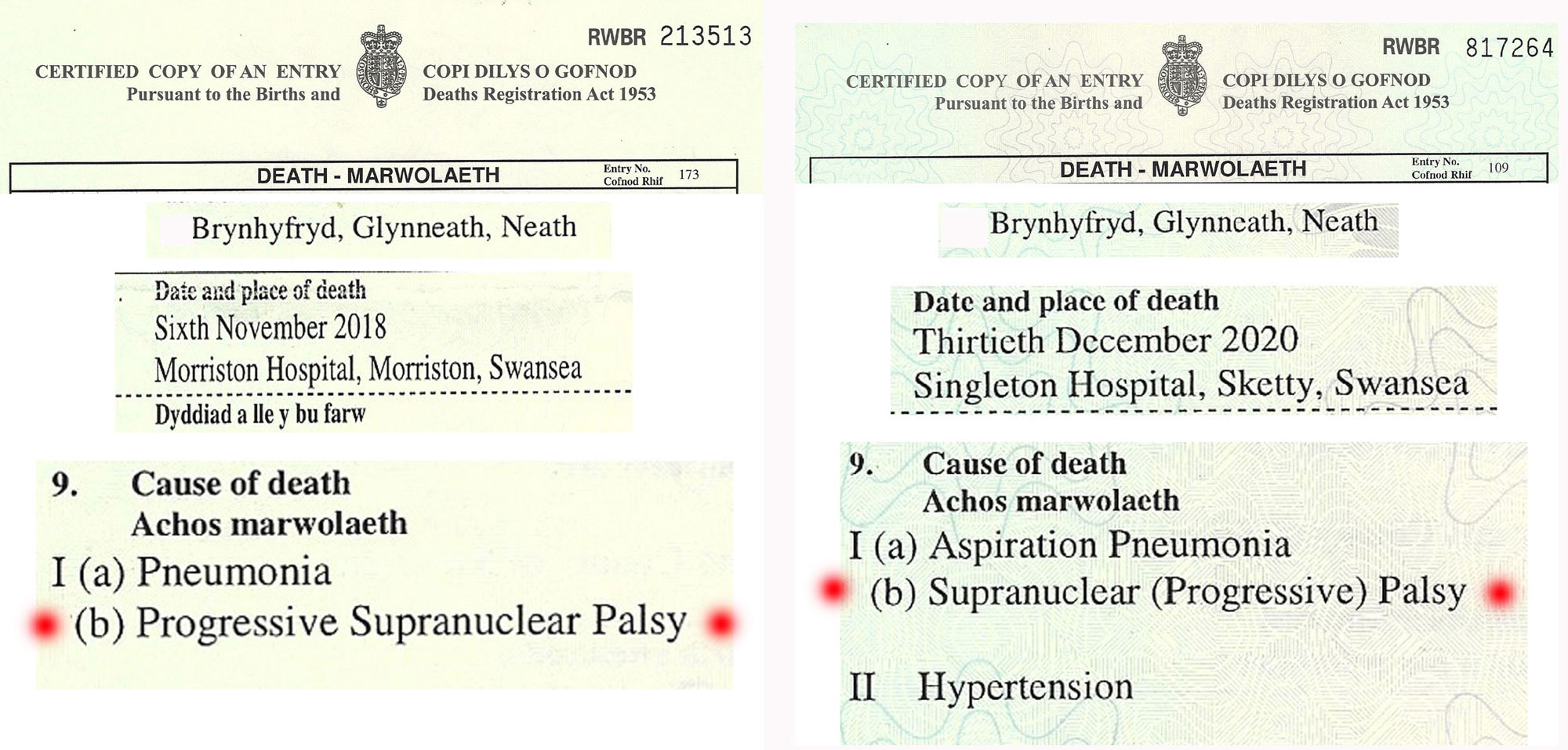
relevant information on two Brynhyfryd residents’ death certificates
The incidences or national average of Progressive Supranuclear Palsy cases occurring in the UK are 1 in 100,000 people per year. Glynneath is a town of just under 5,000 people. This being the case, the expected incident rate of PSP occurring in Glynneath is approximately 1 case in every 20 years or 2 cases in 40. That 2 cases have occurred in a group of 5 houses and that both cases were diagnosed within a period of 2 years of each other is a serious cause for concern and as such these incidences must be considered a ‘cluster’.
We take the meaning of a cluster here to be:
"A cluster is the occurrence of a greater than expected number of cases of a particular disease within a group of people, a geographic area, or a period of time."
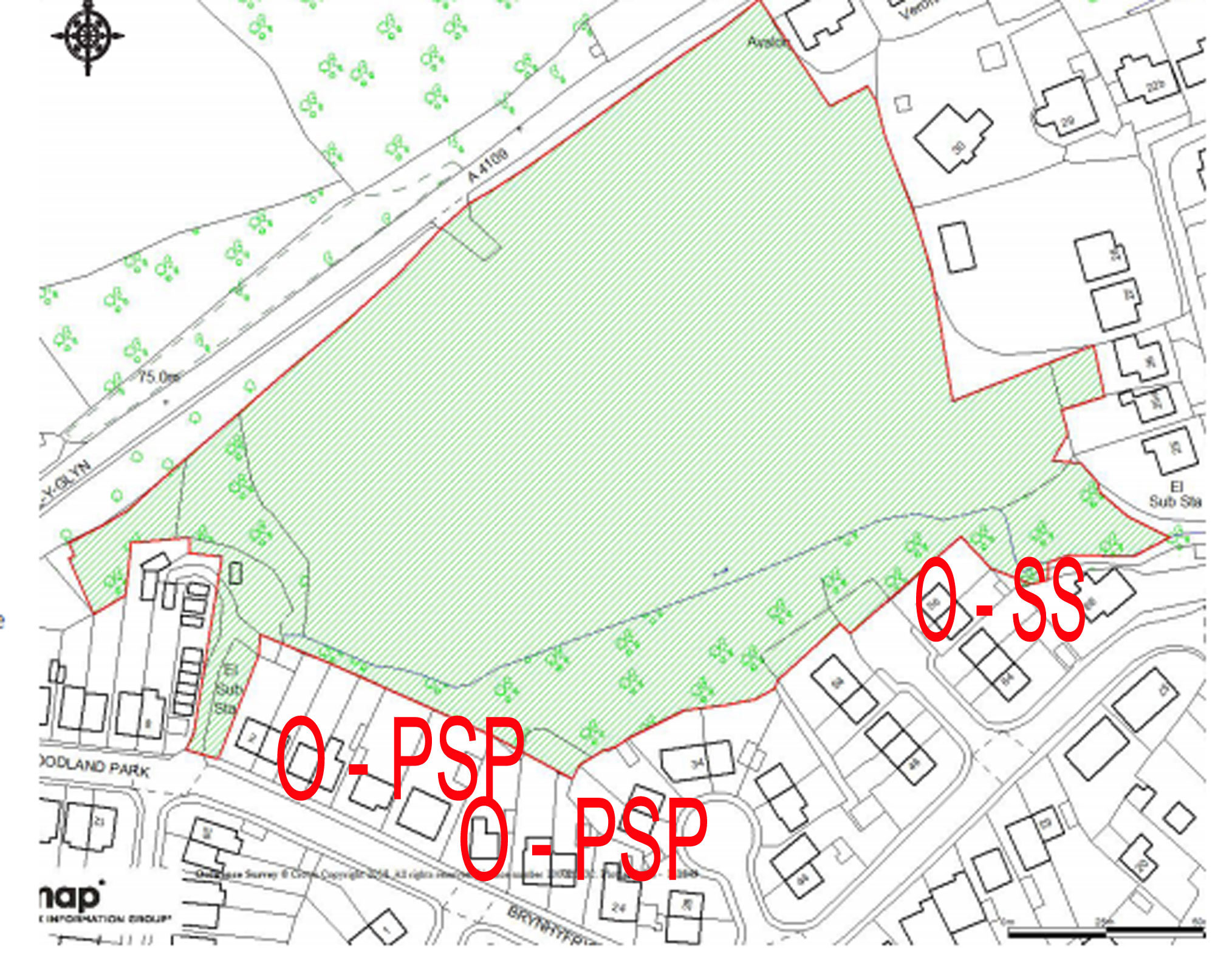
Locations of rare neurological disorder deaths in Brynhyfryd houses bordering the Heol y Glyn landfill site.
Research into Progressive Supranuclear Palsy clusters by relevant health professionals with an interest in the disorder show that the only previously recorded cluster of PSP is in the French town of Wattrelos, a scientific paper published in relation to the cluster concluded that:
"We have identified a cluster of Progressive Supranuclear Palsy in a geographical area with severe environmental contamination by industrial metals."
I have taken the following quotes from the same published scientific peer reviewed paper which are relevant to the Glynneath cluster:
"Wattrelos is a town in northern France where textile dyeing plants and tanneries operated for most of the 20th century, using arsenic and chromate from the nearby chemical plants. Arsenic and hexavalent chromium contamination have been documented in the soils of the sites of former plants in Wattrelos and Leers, where the cluster of PSP cases described in this report live."
"Arsenic, a potential neurotoxin, has been found in the soil at the sites of the former chemical plants in Wattrelos and is present in the phosphate ore formerly processed there, as described also in [Arsenic pollution in Multan] Pakistan. Contamination with chromium is common in Wattrelos, but we consider it to be a less likely candidate as a neurotoxin although a synergistic toxicity with arsenic is possible."
Both chromium and arsenic have been found in chemical testing at the Heol y Glyn landfill site along with other contaminants. Cuddy Group Ltd, the demolition company that previously owned the site had demolition contracts within the steel industry and chemical industry during the period in which they tipped at the site (2003-2016). They were specialists in the removal of asbestos and there are resident’s eyewitness reports of asbestos being tipped at the site and sealed barrels potentially containing toxic waste being buried deep at the site. The Cuddy Group regularly excavated deep holes in which to tip waste suggesting that they didn't want the contents of a particular consignment of waste to be discovered or tested.
REPORTS OF CONTAMINATION & TESTING
The site was chemically tested in 2008 and found to be contaminated. This contamination should have been remediated as suggested by the geo-technical report in which it was contained. However, this information was withdrawn from the planning process, it then remained hidden in the council archives until I discovered it in 2020. There is no record of site remediation or conditions imposed in future planning permissions in relation to this identified contamination.
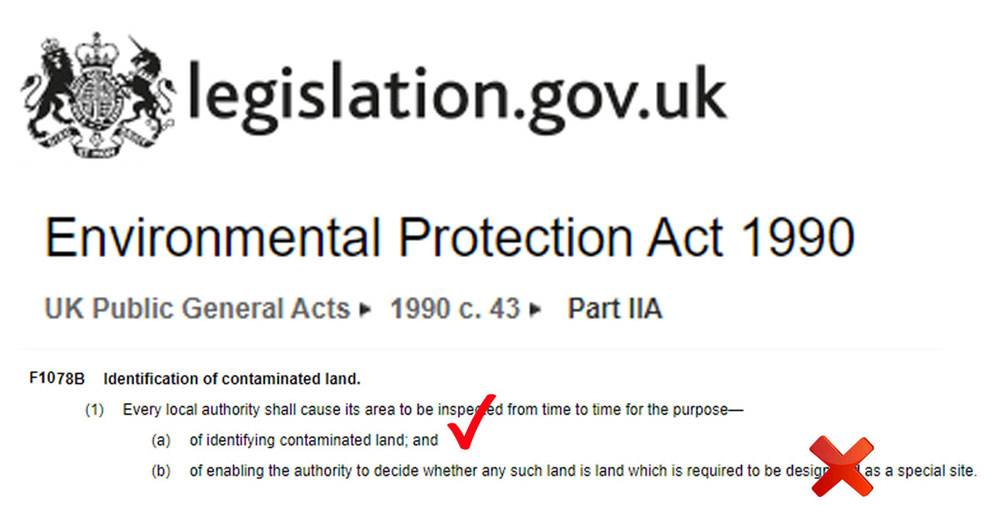
Subsequent research into the Neath Port Talbot Council Contaminated Land Strategy and Environment Agency documentation of the period shows that the council had a duty to investigate the identified contamination further. Failure to do so breached the 1990 Environmental Protection Act. Both the Glynneath Town Council and Neath Port Talbot Council were informed of this breach in April 2020 and we (East Glynneath Residents Against Contamination) submitted a draft report to the Neath Port Talbot Council Planning Committee for consideration prior to a meeting on 8 September 2020.
Additional to our draft report, during the planning committee meeting of 8 September 2020, the current Neath Port Talbot Contaminated Land Officer confirmed the breach of the 1990 Environmental Protection Act by indicating that the testing of the land in 2008 was very limited, the sampling shallow and his opinion was that the testing was not sufficient enough considering the site as a whole.
This confirmed the findings of the EGRAC draft report submitted to the Planning Committee for that meeting that because the land was identified as a danger to human health in 2008 further chemical testing should have taken place as required by this UK Government law. The council’s failure to do so is a clear breach of the 1990 Environmental Protection Act and of the purpose for its existence which is “to serve and represent the interests of its citizens and communities”
Neath Port Talbot Council have failed to respond to the submitted report and have also refused to provide evidence of due diligence taken in relation to the findings of the report. They have refused to provide any further relevant information even when Freedom of Information requests have been made.
The Heol y Glyn landfill site has been misrepresented on the Local Development Plan to show it as a suitable location for a housing development. It is a former ‘council’ ash tip and so historically the land has been used as both a domestic and industrial landfill site for the majority of the last 80 years. There were several years of unregulated tipping at the site by the former owners, the Cuddy Group. The Cuddy group was a specialist industrial waste disposal company and at one time was billed as the 12th largest demolition company in the world. The combination of the historic domestic tipping and the more recent unregulated industrial tipping, together with a failure to treat contamination when identified at the site in accordance with the land contamination protocol are evidence factors that suggest the contamination is the probable cause for the deaths of the two residents with the Progressive Supranuclear Palsy disorder.
RELEVANT AUTHORITIES:
The relevant authorities who exist to support the residents bordering the Heol y Glyn landfill site, namely Natural Resources Wales, Neath Port Talbot Council and Glynneath Town Council, have refused to investigate the concerns of the East Glynneath Residents Against Contamination group or undertake due diligence on their behalf in accordance with their purpose. Their actions in relation to our concerns can be shown to be actively covering up the site’s historic use as a domestic landfill site and any illegal tipping that may have occurred at the site by the former owner, the Cuddy Group. It can be seen in supporting information to this document available on-line that these organisations are also covering up their own malpractice and/or negligence following the identification of hidden contamination by this resident’s group. This is contrary to UK, Welsh and local government guidelines on the duties of public office holders.
ACCOUNTABILITY
The Glynneath Town and Neath Port Talbot Councillor, Del Morgan and the Neath Port Talbot planning department were made aware in January 2017 of the suspicious tipping activities of the Cuddy Group. It is clear from the subsequent events that NPT Council have failed to follow up on these reports to investigate the land and protect the health of neighbouring residents. This failure to address illegal tipping and historical contamination relating to domestic tipping implicates the Neath Port Talbot and Glynneath Town Council’s in the past and future deaths of any residents resulting from the contamination at the site.
SUMMARY:
Progressive Supranuclear Palsy is an extremely rare neurological disorder. The national average occurrences and subsequent deaths for the whole of Glynneath for PSP should number 2 in 40 years. That two deaths from PSP have occurred in a group of 5 houses in Brynhyfryd in a space of two years indicate that these deaths are unnatural. The only scientific study of this disorder of a previously known cluster concluded that the cause was most likely due to industrial contamination. The houses border a historic domestic and industrial landfill site that was tested as contaminated in 2008 but not remediated in accordance with the United Kingdom law the 1990 Environmental Protection Act.
The cause of these deaths from Progressive Supranuclear Palsy is almost certainly due to previously identified and other potential illegally tipped unidentified contaminants at the site. The deaths could have been prevented if council land contamination protocol had been followed, but subsequent council malpractice and the continued active cover up operation has allowed the recorded contamination to remain on site and additional tipping to occur. Neath Port Talbot Council staff and councillors, together with Glynneath Town councillors have been identified as actively covering up and perpetuating the existence of contamination at the Heol y Glyn landfill site. The recorded PSP deaths of Brynhyfryd residents and any future deaths from PSP or other related contamination illnesses such as cancer must be considered as unlawful killing and those public officers covering up the contamination must be held responsible for the deaths.
CONCLUSION:
“Residents of Brynhyfryd are dying from the rare neurological disorder Progressive Supranuclear Palsy. These deaths are almost certainly due to specified and other probable unspecified contamination tipped at the Heol y Glyn landfill site. Public officers who have covered up this contamination are potentially responsible for the unlawful killing of these residents.”
ENDS
***** |