| AIM – To look at the possibility that Football at Rugby School was born at the school and that it started of its own accord without any influence from external sources. Children in a healthy environment like the playing fields of Rugby School will adapt to their environment and improvise with the things around them to have fun. It’s the natural thing to do. What do you think would happen if you threw a ball of any shape or size onto a field of 150 boys at Rugby School? Even if they didn’t know what it was, the boys would have been powerless to ignore it, instinct would have taken over and some sort of game would have ensued. Let’s look at the first set of laws laid down in 1845 at Rugby School: “That all fellows not following up be strictly prohibited from playing any game in goal, or otherwise conducting themselves in any way which shall be deemed prejudicial to the interests of their side.” – FORU004 The fellows who were not following up were the young boys stuck on the goal line, supposedly keeping the goal, but the goal was over the crossbar and too high for even the tallest boys to stop the ball. Unless of course they climbed onto the crossbar, which is why in the 1846 laws rule xix states: “It shall be a goal if the ball goes over the bar (whether it touch or no) without having touched the dress or person of any player; but no player may stand on the goal bar to interrupt it going over.” – ORSR030 If we think back to the evolution of a game, we’ll see that these two laws are solving problems. The ‘no games in goal’ rule was introduced because the boys keeping goal had very little to do, so they invented games and things to do while the main game was going on. “Whilst keeping goal and immediate attention was not required, games were often played by juniors, an old glove, stuffed with leaves, serving as a substitute for a football.” – MBRN074 These games were probably far more interesting for the boys and they most likely forgot about the main game; so when they were called upon to make a play in the main game their minds were likely elsewhere. The ‘no player may stand on the crossbar’ rule was probably a result of a player or players having done this during a game, and so the rule was likely introduced to avoid a repetition of this dangerous act. It appears in the 1846 rules but not in the 1845 version, so we can assume that this happened between these dates. Once a game has a set of written rules, it’s far easier to track its evolution with respect to the aims and actions of the players. This can be done through the rules and the memories of the players. Looking at the evolution of a game before the first set of written rules, however, is a bit trickier. We have to rely solely on any available reminiscences of the personnel involved. With Football at Rugby School, we can be thankful to the Old Rugbeian Society Report of 1897 for recording the memories of those who played the game before the first set of written rules were put in place. This gives us some insight into how the game was played in 1813, by Matthew Bloxam, and by others in the years leading up to the first written rules of 1845. As we stated previously, the key to rugby football is the crossbar – the aim of kicking the ball over it and not under it. With this in mind I ask myself, has the origin of rugby football been under our noses the whole time and we just haven’t seen it? Were Marshall, Shearman and the ORS toying with us? Let’s look at the picture of the Close at Rugby School on the first page of Marshall’s book: 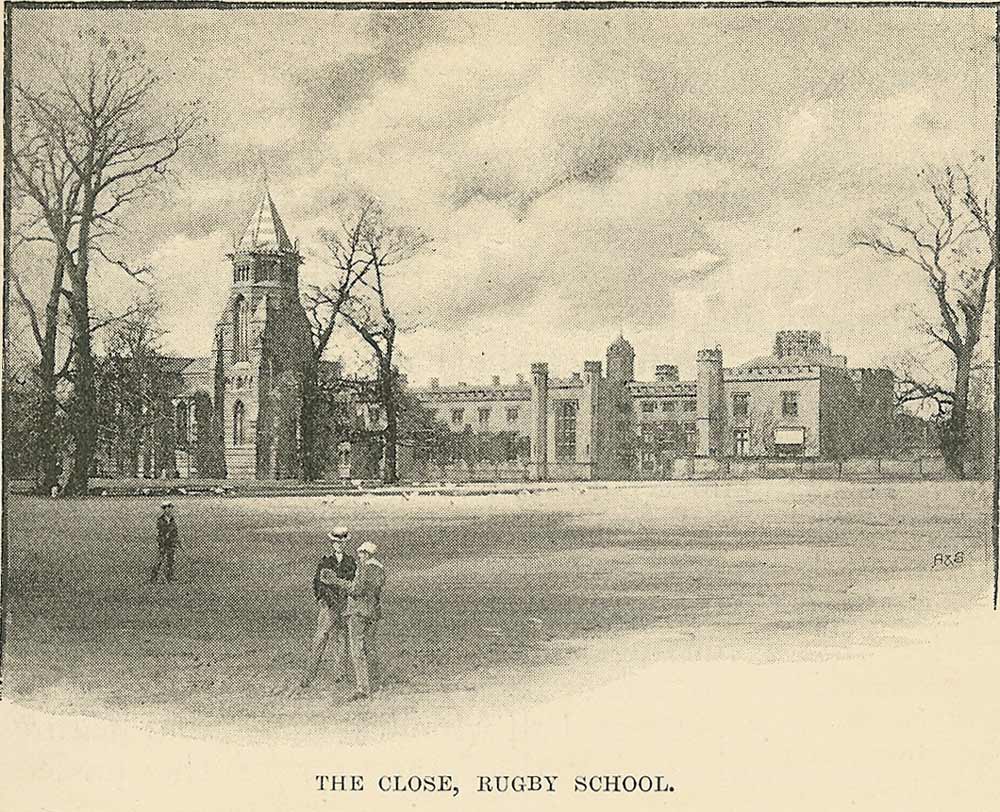
Notice anything familiar in the picture? - (FMRU001) 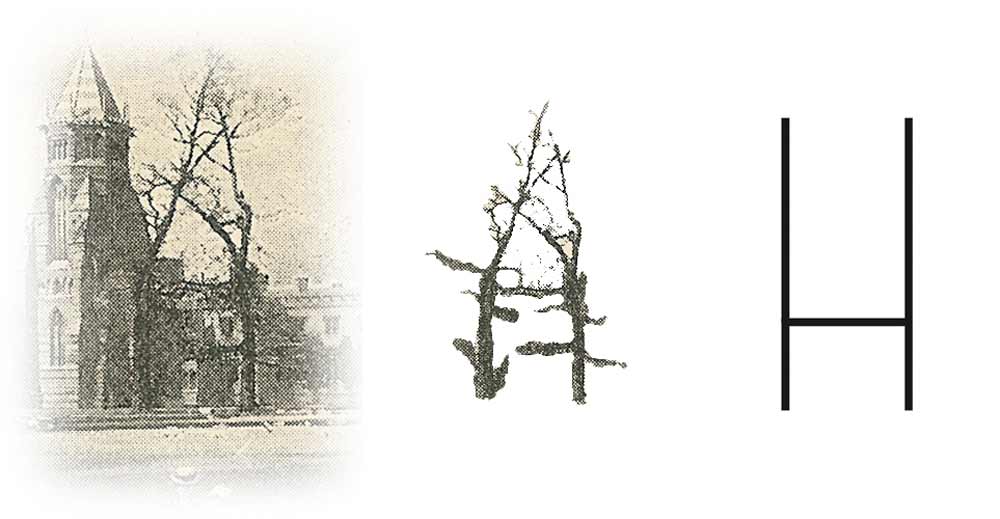
I’m not sure how old this picture is, but imagine those trees 50 years earlier. They’d be a lot smaller and would look just like the rugby posts on the right. Are rugby posts the shape that they are because they were originally two trees standing together? Or maybe it’s that one post represents one tree, the crossbar represents a branch and the other post is just a support for the crossbar? Look at how many trees there are on the Close at Rugby School in this painting and look at where the posts are in the white circle. They are right in front of the trees. Is this because the trees grew too tall and the posts were placed next to where the original goals were? 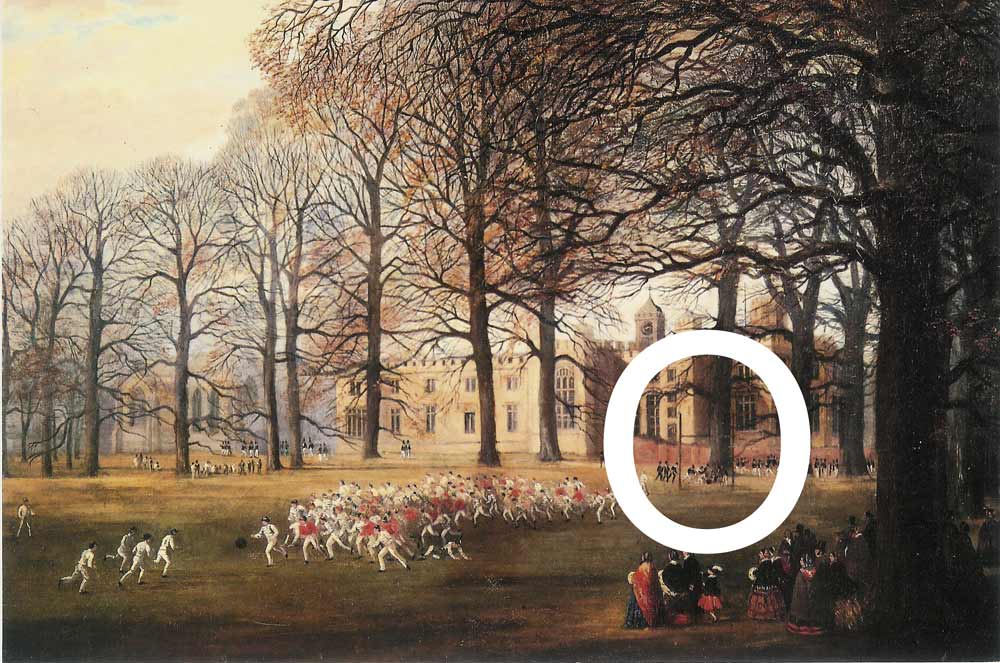
There was no Webb Ellis legend that survived at Rugby School but there are legends about the trees in Rugby School Close. TREEN’S TREE – In Bloxam’s 1880 account he talks about the ‘famous Treen’s Tree’ that was felled in 1818 to make way for the chapel. It can be seen on the left-hand side of this 1809 illustration of the Close: 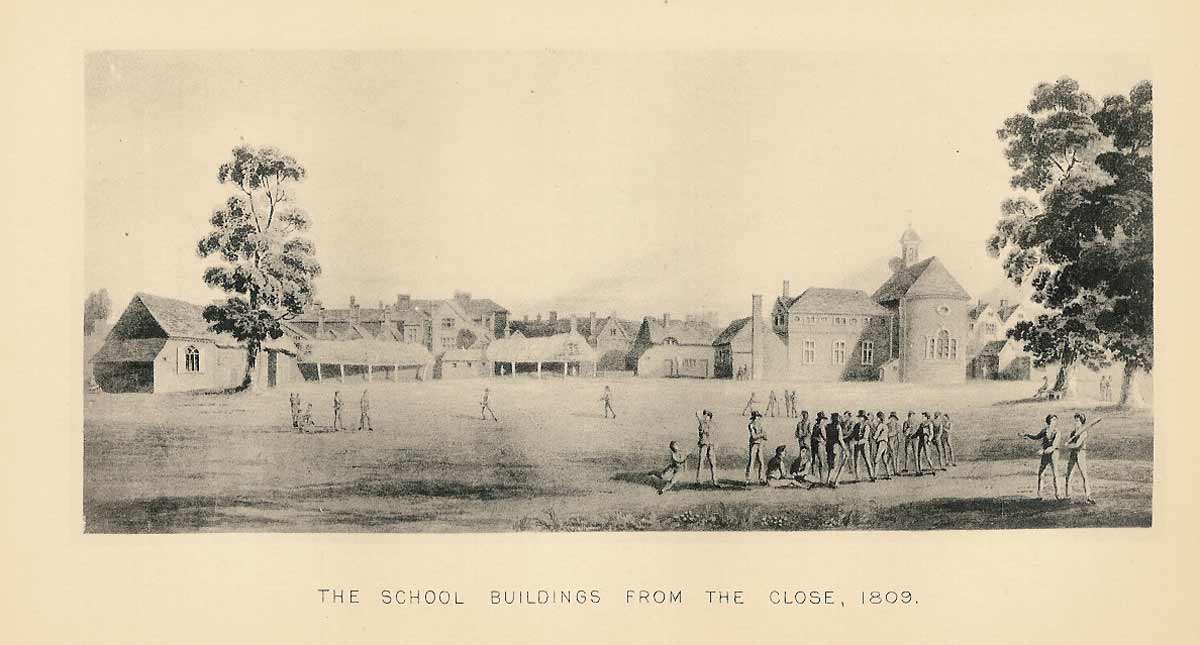
‘Treen’s Tree’ warranted a chapter of its own in ‘Rugby – The School and its Neighbourhood’, which was compiled from the edited writings of Matthew Bloxam. The school antiquarian opens the chapter with: “To old Rugbeians up to the year 1818 no object in the School Close was of more interest than the famous elm, yclept “Treen’s Tree,” the site of which is now occupied by the western portion of the Chapel. It was the monarch of the elms in the Close…” – MBRN092 According to HC Bradby (HCBR088), Treen’s Tree was named after the Treen family who held the farmyard in which it stood. THREE TREES – These were part of the original Bigside (pitch). “To a later generation the best known trees were a little group of three large elms, called the “Three Trees,” which stood a little apart from their neighbours, about the middle of the ground as it was before the last addition; they were within the limits of the football ground, and many a Rugbeian can still remember bruising himself against them; two of the three fell in 1881, but the remaining one retained the name, no longer applicable, till it shared the same fate in 1895.” – HCBR088 TREES IN THE RULES – “Rule xviii. – A player having touched the ball straight for a tree, and touched the tree with it, may drop from either side if he can, but the opposite side may oblige him to go to his own side of the tree.” – FORU012 CLIMBING TREES – Edmund Lally, aged 12, died in a fall from a tree which he had climbed to sit and read (MBRN097). ROLLER TREE – In the second chapter of Marshall’s book, Guillemard says “… no trace is left of the Roller Tree which trespassed on the field of play on the Barby Road side of the ground.” (FMRU016). CASE’S GALLOWS – “Nor must we forget the tree that helped to form Case’s Gallows, a peculiar goal set up in his school days by the present Waynflete Professor of Moral Philosophy at Oxford in which the cross-bar was formed by a horizontal branch of a tree which met the short arm of the “gallows”. It stood between Old Bigside and the Chapel Piece.” – HCBR089 Although Case’s Gallows were named as such after a post Webb Ellis Rugbeian, it shows that the boys were in the habit of using tree branches as crossbars. Case attended Rugby School 1858–1863 and the branches were most likely used as crossbars at ‘puntabout’, which was the term used by the boys for a ‘practice session’. Kids love trees – climbing them, running around them and using them as targets. Look again at the goalposts; the crossbar is the key. It is very easy to imagine that the original crossbar would have been the branch of a tree. If you look again at the map in the 1895 report you can see that the ‘three trees’ had a fence running through them. Was this fence the original reason why the ball was kicked over the branch rather than through the trees? STREET FOOTBALL IN RUGBY TOWN Let’s go back to the time when Rugby School had no playground and was located in the middle of Rugby town. Some form of street football was played in the town of Rugby in the mid eighteenth century but it didn’t survive. To quote from Jennifer Macrory’s book: “The Rugby game in particular has been regularly portrayed as a survival of ‘primitive’ football, generally on the grounds that carrying the ball is permitted. Certainly football was played in the town of Rugby in the middle of the eighteenth century. The Constable’s books indicate that New Year’s Eve rather than Shrove Tuesday brought football trouble to Rugby, and the entry for 31 December 1743/4 reads ‘Pd Baxter for Crying no football play in ye street, 2d’. Whatever form this local game may have taken it certainly did not result in the direct translation of the carrying game to the playing fields of the school, where the game played at the turn of the century distinctly forbade running with the ball.” – JMRB014 The Constable’s book says “Pd Baxter for Crying no football play in ye street, 2d”. It says nothing about running with the ball; it just says ‘football’. If we refer back to Shearman and his different types of football, and to Routledge who refers to everything as football, we know that many different forms of football existed and we just don’t know what type of football this was. We don’t even know if it was a game of football; it could just have been a group of people playing and kicking a ball back and forth to each other. Neither does it say that this was an annual event: it could have been that a group of adults or kids had been playing football in the street every day since just before Christmas that year and that they had smashed so many windows that the constable decided he’d better do something about it – he paid the town crier to cry ‘no football play in ye street’ and if anybody did he’d have just cause to arrest them because they were warned. Let’s have a look at what was happening at Rugby School in 1743. It was without a playground and had just seen an influx of boarders after the appointment of a new master, Rev. Thomas Crossfield, in 1742. This is what Bloxam said about that period at Rugby School: “In 1742, on the resignation of the Rev. John Plomer, the Rev. Thomas Crossfield was elected master to succeed him, and no one ever came to preside over the school with a greater prestige. In the first year of his mastership, fifty-three boys were admitted to the School, two only of whom were town boys. Of the remainder, one half were from the neighbouring county of Northampton, the other half from different parts of the kingdom. The expectations of a brilliant school career were frustrated by the early death, after a brief tenure of office, of Mr. Crossfield, in the thirty-third year of his age. The rush of scholars to Rugby during the early part of Mr Crossfield’s mastership exceeded the number that could be accommodated in the Master’s house, and accommodation had consequently to be found in the town; and it was during Mr Crossfield’s mastership that I first find boarding houses alluded to…” – MBRN057 With the school building dilapidated, it’s unlikely that any more pupils could have been accommodated under Crossfield and in 1744 only four pupils entered into the school. Of the 51 boarders who entered in 1742 I have identified at least four from the Rugby School Register who would have been very likely to have spent the Christmas period of 1743 at their boarding house in Rugby: Thomas Page, who was an orphan, and Thomas & John Brewster and Thomas Gibbs, all of whom were ‘Barbadoes’. I’m assuming that this was a misspelling of Barbados, which was a British colony at the time. For these last three it would have taken them months rather than weeks to travel home and back again. These four could have been our football players and there may even have been more boarders residing at Rugby over Christmas and the New Year. If we refer back to Apperley and his saturnalia comment, just 45 years after this date, we get an idea of what these boys were like. I’d say that it is quite probable that they were involved in playing football on the street. So is this then the origin of Rugby Union? It’s possible, but very unlikely. If these boys played football and developed a game with rules and that game evolved into the same one when the school moved seven years later and that game was still the same game that evolved into the one that Matthew Bloxam was playing, then yes, it is the origin. The boys of Rugby School may have played street football in 1743 but there is no record of that game or play having survived. If it had then I think there would have been mentions of arrests for ‘football play’ in the Constable’s books. If these boys had footballs they might have taken them to the churchyard where they were reprimanded by the rector for playing there. Perhaps they took balls out to the fields surrounding Rugby and developed a game there? Or perhaps they just put the ball in a cupboard and forgot about it? The school moved in 1750 to its new location – a manor house with grassy fields and trees. If the ball then came out of the cupboard we now have all of the ingredients needed for the birth of Rugby Union. The term ‘puntabout’ appears at a later date in Rugby School folklore. This is where the boys kicked the balls back and fore to each other. Was ‘puntabout’ an early form of training, or was it the early form of Football at Rugby School? Let’s explore the possibility that it was the latter. Let’s invent a game………… Location = Rugby School Close, trees Location + personnel = Rugby School Close, trees, two boys Location + personnel + equipment = Rugby School Close, trees, two boys – one of whom is a butcher’s son who brings a pig’s bladder to school Location + personnel + equipment + action = Rugby School Close, trees, two boys, a pig’s bladder, punting the pig’s bladder back and fore to each other Location + personnel + equipment + action + aim = Rugby School Close, trees, two boys, a pig’s bladder, punting the pig’s bladder over a fence and a tree branch before the other boy punts it back. (They have developed an aim; this is ‘puntabout’). The pig’s bladder looks to be too light and one of the almsmen who helped with the move to the new school sees that the boys are having problems with it and remembers where the football is. He gives it to the boys who welcome the heavier pig’s bladder encased in leather. More boys join in, with two then three a side. Charlie decides that it would be a good idea if when the ball went over the branch, the kicking team would score a point. The team with the most points at the end of play is the winning team. A game is born and we have: Location + personnel + equipment + action + aim + verbal rules = game It’s now time for the game to evolve. To do this we need to: 1. Solve any problems that occur (problem solved) 2. Take opportunities to enhance the game wherever possible (enhancement made) Charlie’s team keep losing because Huw can’t kick straight but he notices that Billy on the other side drops the ball more often than not, so Charlie, who is senior to the other boys, makes up the rule that if the receiving team catch the ball cleanly without it touching the ground then that point doesn’t count. (Enhancement made) Charlie leaves the school but most of the other boys remain and of the new intake there are 13 players who want to join in. The new players are shared amongst the teams and the game continues, but players keep bumping into each other and a number of injuries occur. The ground churns up and is muddy on one side only, while the other side remains firm and dry. Several of the boys on that side have slipped, fallen over and were punished for bringing mud into the schoolroom. Mike, the new senior boy amongst the players, decides that all of the boys apart from two catchers, one from each team, should move to the dry side and that the catchers still need to take the ball cleanly and then throw the ball back under the branch to the kickers. Kicks would then be taken alternately by each side. (Problem solved) Specialist play starts to take shape. The best catchers from each side remain on the muddy side. Mike notices that the catcher in his team is not as good as the other team’s catcher, so he makes up the rule that once a player has caught the ball he must rotate with other players in his team and must not become a catcher again until everyone else has had a go. (Enhancement made) Huw remains a weak kicker, so Mike details a group of 20 fags to stand in strategic points so that if the ball goes astray from Huw’s boot then they can bring it back into play quickly. (Problem solved) Ten more senior boys turn up and want to play. The new boys are all from School House, making 24 seniors in total. Mike complains and tells them that there is not enough room for any more players. Ben, who wishes to join, is more senior in the school than Mike, so he tells him that they will join in and that they will all play in a bigger area and also use the branch of a different tree about 20–30 yards away. The catchers split up and move to the different trees. The ten new boys want to stay together so they make up one team and replace the catcher with one of their own. It’s now ten School House boys against 14 of the rest of the school. One of the School House boys has an injured leg so they revert to having only a single catcher and they offer the option to the other team. (Problem solved) As the nature of the game has changed with the multiplication of the ‘goals’, several problems occur immediately and are subsequently fixed. The School House goals are at an angle and the branch (crossbar) is higher than that of the other goals, so the rest find it more difficult to kick the ball over the branch to score a goal. Four fags are detailed to hold up a tall broken branch at a better angle and it is agreed that the ball has to clear the top of this post to constitute a goal. (Problem solved) The wind is blowing behind School House and they are leading 5–0. The rest are struggling to score a goal. Little Tommy kicks the ball and the wind catches it and takes it over the bar where it’s caught by the School House catcher. School House claim a point but the rest dispute it because it wasn’t a School House player who kicked the ball. The rest also complain about the wind and suggest that they change sides after every goal scored. Ben says OK. (Problem solved) The game recommences with the teams changing sides after every goal. The catchers have to travel the furthest and the other players are annoyed at how long they are taking. Mike suggests to Ben that they do away with the catchers. The School House catcher is the better of the two but the other catcher is taking an age to cross over, so Ben agrees that it’s a good idea. A point is once again awarded when the ball crosses over the branch. (Problem solved) The four fags holding the goalposts get bored and start to mess around with their post. It falls on one of the boys and injures his shoulder. The headmaster wants to know how this happened and decides that post holding is too dangerous. He orders a local carpenter to build a set of posts that look like the original trees and has them installed at the correct angle. The carpenter erects the posts while the boys are in lessons but he couldn’t find anyone to tell him at what distance to place the posts from the original trees. He is in a rush and has no idea how the game is played so he places them at a distance of 120 yards. The boys arrive to play and are astounded at the distance between the goals. Immediately they crowd around each other and begin a discussion on how to overcome this problem. It is decided that a player can kick the ball to his own player to advance the ball forward towards the opponent’s goalposts. If the ball was caught then the next player could also kick it forward. But if the ball hit the floor then it was turned over and the other side could kick to advance. The game is still non-contact. The team without possession is not allowed to challenge for the ball – they must wait until the ball is dropped before they can claim it. (Problem solved) Spring arrives and the goalposts, which on one side are trees, have heavy foliage and the ball keeps getting stuck in the trees. It is decided by the eldest boys, who have made a committee of 4 to adjudicate on the rules of the game, that the ball should be kicked off the floor because of the lower trajectory of flight. Therefore, when the ball is caught by a player who thinks that he can score a goal, he puts the ball down, retreats and attempts a kick at goal. (Problem solved) The senior boys are chatting over lunch. As a group they have become dissatisfied with the game in general and the lack of action during matches. They discuss the nature of the game and how it seems that the team without the ball has nothing to do except watch as the other team progresses upfield. They want to look at ways in which both teams can be competing at the same time. They decide on a radical change. They decide that nobody from the same team can be in front of the player who kicks the ball. Players must follow up from behind the kick and try to catch the ball. This is to be called a fair catch. When a player makes a fair catch, he marks the ground where he caught the ball. The opposing team then stands on the mark and the ‘fair catcher’ retreats and kicks the ball again. The opposing team is allowed to contest for the fair catch but must not impede the player from the kicking side. A new pattern of play emerges. The kicker punts the ball high so that his ‘followers’ are able to cover more ground while the ball is in the air. If the ball hits the ground first or is dropped by the team in possession then it is turned over. If a defending player touched the ball last before it hit the ground then the attacking team keeps possession and makes their mark at that point. (Enhancement made). The game is played in this way until the end of term. The boys return home for the summer, before coming back for the Michaelmas term. A new senior boy, Arthur, joins and numbers have been reshuffled over the summer period and it’s now 17 School House boys against 28 from the rest of the school (including Arthur) with about 50 fags dotted around the touchlines and goal lines as ball boys. These fags mark the out of bounds areas but have no allegiance to either team. Arthur is a big kicker; he starts by following the previous strategy of kicking the ball high but then changes his mind and starts to kick for length rather than height because his team are only catching a low percentage of the kicks. The ball is quite often coming to rest near or beyond the opposition goal line before the defending team pick it up and kick it back. School House are continually losing distance because their kickers are not as powerful as Arthur. Ben (in his last year) suggests to the other senior boys that if the ball is on the floor then players are allowed to hit it with their hands or kick it forward towards the opposition goal in order to gain ground and keep the game in motion. The fair catch principle still stands if the ball is caught directly from a kick or a bounding ball. The kicker still makes a mark, and retires while the opposition advances to the mark. But if the ball is rolling or close to the floor then it must only be kicked or propelled forward with the hand; it is not allowed to be picked up. The other boys agree. (Enhancement made). The game becomes more competitive with the introduction of kicking the ball on the floor and even fewer goals are scored. Attempts at goal are taking too long as a player has to catch the ball, place it, retire, then kick it. The game has developed a good tempo and levels of fitness amongst the boys are starting to improve. The senior boys want to maintain this tempo and bring in a rule that catchers are not allowed to kick at goal, and instead they must place the ball and a ‘following up player’ must take the kick. As soon as the catcher places the ball and the ball touches the ground then the opposing team may rush forward to attempt a block of the kick. Timing is critical and kicks are regularly charged down. (Enhancement made). The senior boys are discussing the rules at length during lunch again and because it is a nice dry sunny day they reconvene their discussion on the Island. There are now six of them and they work well together so they decide to give themselves a name: ‘Bigside Levée’. The game is now mainly a kicking and catching game; punts are both long and high and normally the catcher has little time to field the ball. When it is dropped, 20 or 30 boys set upon it immediately and try kicking it towards the opponent’s goal. Not all of the boys join the scrummage; some stay out judiciously waiting for the ball to appear. The rules stay the same for a number of years and the natural tree goalposts are replaced by artificial posts. The pitch is lengthened and the trees are natural obstacles on the pitch that are incorporated into the set of verbal rules. Goals are now rarely scored and matches can go on for days without a score. One day, as was usual, a boy caught the ball in his arms. This being so, according to the rules, he should have retired back as far as he pleased, without parting with the ball. The combatants on the opposite side could only advance to the spot where he had caught the ball. They were unable to rush forward until he had either punted it or had placed it for someone else to kick. This boy disregarded this rule, and upon catching the ball, instead of retiring backwards, rushed forwards with the ball in his hands towards the opposite goal. The Bigside Levée got together and passed a rule that if that happened again then the boy should be hacked over, that is, have his legs kicked out from under him. (Problem solved) At the start of this process we had two boys with a ball and at the end we had a game with rules. The final action in this sequence, and I hope you recognized it, was the William Webb Ellis event. I wanted to include this to show that in this hypothetical game invented at Rugby School, he was not the inventor. The inventor of the game was Charlie because he devised the rule that made kicking over the crossbar the aim of the contest. In the evolutionary path, he had invented the game: Location + personnel + equipment + action + aim + verbal rules = game SUMMARY – We’ve seen that the boys of Rugby School may have played football as far back as in 1743. When the school moved to the Manor House, the Close had all of the ingredients needed to start the game of Football at Rugby School. If a ball had been thrown onto the Rugby School Close while the boys were playing, it’s inconceivable that they would have ignored it. Some sort of play would have commenced immediately and then a game would eventually have been born. We have shown that the trees on the Close were probably involved at some early stage in the development of the game. We have also shown how a game could have started and we have suggested a potential theoretical link from that start to the earliest known form of the Football at Rugby School game. Therefore, we must agree that it is possible for the game of Football at Rugby School to have been born there between 1742 and 1809. CONCLUSION – It is possible that Football at Rugby School was born there and if this is the case then the origin of Rugby Union can be placed at Rugby School. FOOTNOTE – In an early draft of this chapter I included the word ambididdlemous but this somehow has been edited out. This word means the inability to tell left from right, there are thousands, maybe hundreds of thousands of people who can’t tell their left from their right; you may be one of them. I just wanted to use the word in this book because it is one I made up about 15 years ago during a made up game in the swimming pool. People have started to use it, there was a discussion on Radio Scotland about it and someone has suggested it should be included in the Collins dictionary. The world needs this word, please use it, please tell your friends about ambididdlemous. Moving on and back to sumspeed, did you believe that 77 x 77 = 5939 without checking first? Because the answer is really 5919 and I was just showing you how easy it is to believe everything that you read. Before you had a chance to think about it, I moved you on by talking about a related subject and then changing the subject completely with a bad joke. Unless you were very thorough and checked, you would have assumed that I knew what I was talking about and believed that 5939 was the correct answer. That’s how the Old Rugbeian Society got away with the report, because it was titled ‘The Origin of Rugby Football’. Once people read the title and they were told that Bloxam had stated that the Webb Ellis event was the origin they believed that they were reading about the origin of Rugby Union, whereas we now know differently. Nobody checked what Matthew Bloxam had actually said. We’ve now checked to see if Football at Rugby School was ‘created’ or ‘born’ and found that it’s possible that it could be either. When I was doing research for this book, at this point my money was on the boys of Rugby School having invented their own form of Football. But I’m not 100% happy with that theory. If the boys of Rugby School had invented the game then why hasn’t Matthew Bloxam mentioned this. I think that we should be asking more questions about Bloxam, so let’s do that. |